
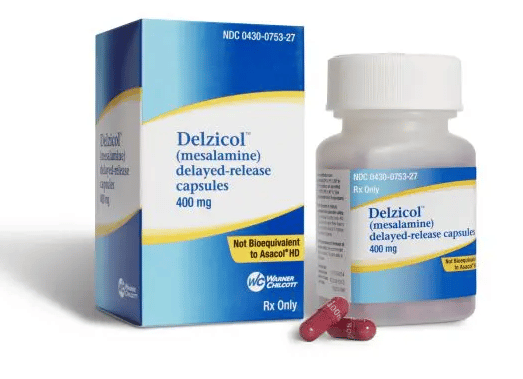
Delzicol vs Asacol is mainly a comparison of mesalamine formulations, not two unrelated drug classes. Both belong to the 5-ASA group used in ulcerative colitis care. The practical question is which dosage form, release pattern, strength, and access path fits the treatment plan your clinician has chosen. That distinction matters because older Asacol 400 mg tablets, Asacol HD, and Delzicol capsules are not simply interchangeable labels.
Key Takeaways
- Same core medicine: both are mesalamine-based 5-ASA therapies.
- Formulation matters: release design can affect daily routines.
- Status can change: older brand lines may be discontinued or replaced.
- Switching needs review: milligrams alone do not tell the whole story.
- Safety is similar: monitoring and symptom changes still matter.
Delzicol vs Asacol: What Actually Differs
Delzicol and Asacol both center on mesalamine, also called 5-aminosalicylic acid or 5-ASA. Mesalamine is a topical anti-inflammatory, meaning it acts mainly on the bowel lining it reaches. In ulcerative colitis, that local action can help reduce inflammation in the colon as part of a clinician-directed plan.
The confusion usually comes from product history. The original Asacol 400 mg tablet left the U.S. market, while Asacol HD has been marketed as a separate delayed-release tablet product. Delzicol was introduced as a delayed-release capsule format. In everyday conversation, people may use Asacol to mean the older tablet, Asacol HD, or even mesalamine delayed-release products in general. That loose language can make switching conversations harder.
Why it matters: A familiar brand name can hide a meaningful change in dosage form.
| Comparison Point | Practical Meaning |
|---|---|
| Active ingredient | Both are mesalamine-based, so they sit in the same broad 5-ASA class. |
| Dosage form | Capsules and tablets can differ in swallowing, pill count, and handling instructions. |
| Release design | Delayed-release coatings aim to protect mesalamine until it reaches the lower intestine. |
| Product status | Older brand versions may be discontinued, while related products remain listed in some markets. |
| Switching approach | Clinicians consider disease location, prior response, tolerance, and adherence, not only total milligrams. |
For many readers, Delzicol vs Asacol is less about which name sounds better and more about whether the formulation still matches the target area of inflammation. A person with disease limited to the rectum may need a different strategy than someone with more extensive colitis. That is why the medication name should be paired with a discussion of disease extent and treatment goals.
Release Design: Why Formulation Can Change the Routine
Oral mesalamine products are engineered to protect the drug until it reaches a chosen part of the intestine. Many delayed-release products use coatings that dissolve at certain pH levels. pH is a measure of acidity. This design helps explain why two mesalamine products can share the same active drug but still feel different in daily use.
Release site is not a minor detail. Some products aim for the terminal ileum, the last part of the small intestine, and the colon. Others focus more heavily on colonic delivery. The label, not the brand memory, should guide how the product is swallowed, whether it can be opened or split, and whether food instructions apply. If swallowing, timing, or pill burden is a problem, tell the care team before changing the product on your own.
In an oral mesalamine comparison, once-daily convenience may help one person, while smaller units or different release behavior may suit another. For adjacent mesalamine comparisons, see Asacol vs Lialda and Asacol vs Pentasa. For a product-level backgrounder on another 5-ASA formulation, Pentasa Medication explains how delivery design shapes use.
Switching and Conversion Are Clinical Decisions
A mesalamine conversion is not just arithmetic. Total daily milligrams matter, but they do not fully predict how much medication reaches a specific bowel segment. Release pattern, dosing frequency, disease extent, and adherence can all affect the real-world result.
This is why searches for a Lialda-to-Delzicol conversion or a mesalamine conversion chart can be helpful but incomplete. A chart may help you compare labels and strengths. It cannot account for whether you have proctitis, left-sided colitis, or pancolitis, which means inflammation throughout the colon. It also cannot know whether your current product controlled symptoms, caused side effects, or was difficult to take consistently.
In a Delzicol vs Asacol switch, your clinician may ask what phase of treatment you are in. Induction therapy aims to calm active inflammation. Maintenance therapy aims to help keep symptoms controlled after improvement. Those goals can lead to different schedules and combinations, especially if rectal therapy is added for disease near the rectum.
Quick tip: Record timing, meals, missed doses, and symptoms after a clinician-approved switch.
Bring the actual bottle, capsule, or tablet name to appointments when possible. Brand names, generic labels, and delayed-release abbreviations can look similar. A pharmacist can also help confirm whether two products are truly the same formulation or only share the same active ingredient.
Side Effects, Monitoring, and Red Flags
Most oral 5-ASA products have broadly similar safety patterns, but they are not side-effect free. Commonly reported issues can include headache, nausea, abdominal discomfort, indigestion, and diarrhea. These symptoms can overlap with ulcerative colitis itself, which makes timing and symptom logs useful.
Kidney monitoring is an important part of mesalamine safety conversations. Some people may need kidney function tests before or during treatment, especially if they have kidney disease or take other medicines that may affect the kidneys. Bring a full medication list, including over-the-counter pain relievers and supplements, so your clinician can check for cautions and interactions.
Side effects attributed to Delzicol, Asacol HD, or other mesalamine products should be discussed rather than ignored. Seek urgent medical help for trouble breathing, facial swelling, chest pain, fainting, or severe allergic symptoms. Contact your care team promptly for worsening bloody diarrhea, high fever, severe abdominal pain, rash, or a marked drop in urination.
There is no single safest drug for ulcerative colitis for every person. Safety depends on disease severity, other conditions, pregnancy considerations, prior reactions, and the risks of undertreated inflammation. Asacol and Delzicol are not steroids. They are aminosalicylates, while corticosteroids and biologics have different roles, benefits, and risks.
How Related 5-ASA Options Fit In
Other 5-ASA options differ mainly by delivery design, activation method, and route. Pentasa, Lialda, Apriso, balsalazide, sulfasalazine, suppositories, and enemas all sit in the broader conversation, but they are not interchangeable for every patient. The best fit depends on where inflammation is located and what the person can take consistently.
Mesalamine vs balsalazide is a common comparison. Balsalazide is a prodrug, which means gut bacteria help convert it into active 5-ASA in the colon. That design can be useful in some situations, but it does not make balsalazide universally better or safer. Side effects, allergies, pill burden, and prior response still matter.
People also ask whether Pentasa is better than Asacol. A more useful question is where each product is designed to release medication and how that matches the disease pattern. For some people, a different release pattern may be useful. For others, it may not solve the main problem. These decisions are best made with a gastroenterology clinician who knows the extent of disease and past treatment history.
Access, Availability, and Treatment Location
Availability can be confusing because market status changes. If you see a notice that Delzicol was discontinued, confirm what that means in your region and at your pharmacy. A product discontinuation does not automatically mean mesalamine was found unsafe. It may reflect manufacturing, market, formulation, or business decisions. The same idea applies to the older Asacol 400 mg product, which is different from assuming all Asacol-related products vanished.
Cost and coverage can also drive switching. Formularies may prefer one delayed-release mesalamine product over another. Some plans require prior authorization. Others may favor a generic version or a specific dosage form. If affordability is the main barrier, ask the care team whether disease location allows rectal therapy, a different oral formulation, or another class.
BorderFreeHealth connects U.S. patients with licensed Canadian partner pharmacies for eligible prescriptions. When required, prescription details are verified with the prescriber before dispensing. Cash-pay options may matter for people without insurance, but eligibility and local rules still apply.
For broad navigation, the Gastrointestinal Medications hub lists medication pages, while the Gastrointestinal Library groups related educational pages. Specific mesalamine examples such as Mesalamine 400 mg Novo 5-ASA and Mesacol OD 1200 mg show why strength, release design, and label instructions should be reviewed before comparing products.
Treatment location matters as much as brand name. Suppositories generally target the rectum. Enemas can reach farther into the left side of the colon. Oral and rectal 5-ASA therapy may be combined in some clinician-directed plans, especially for distal disease. If inflammation remains active despite 5-ASA therapy, clinicians may consider corticosteroids or other escalation strategies. Uceris Rectal Foam is one example of a rectal corticosteroid product used in a different treatment class.
Authoritative Sources
- AGA Clinical Guidance: evidence-based guidance on mild-to-moderate ulcerative colitis management.
- MedlinePlus Mesalamine: plain-language safety, use, and caution information for mesalamine.
- Mesalazine Switching Study: clinical discussion of switching between mesalazine formulations.
Recap
The simplest Delzicol vs Asacol takeaway is that the active drug is similar, but the product details are not identical. Formulation, release design, current availability, pill burden, and disease location can all change the practical choice. If a switch is being considered, focus the discussion on goals, prior response, side effects, and how the schedule fits daily life.
Product names and market status can change. Confirm current labeling, availability, and substitution rules with your clinician or pharmacist before making any medication change.
This content is for informational purposes only and is not a substitute for professional medical advice.


