
Please note: a valid prescription is required for all prescription medication.
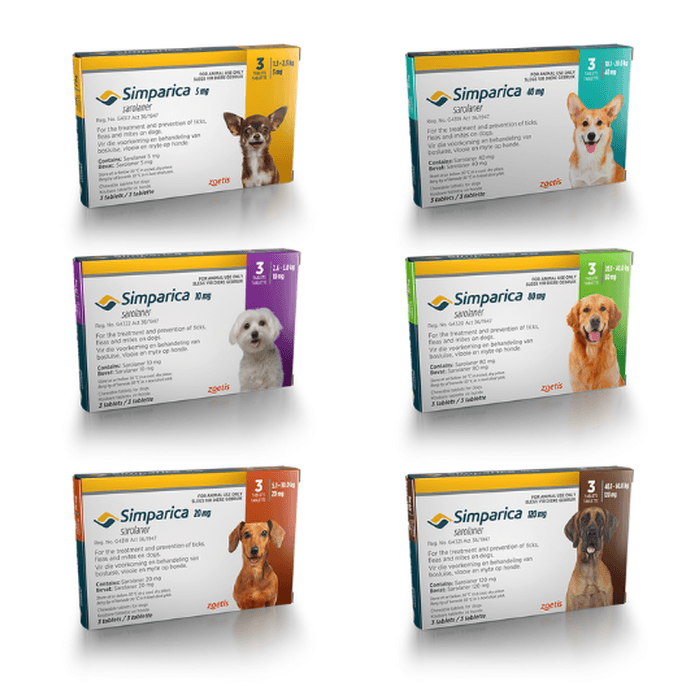
Simparica
Buy Simparica Online
Secure Encrypted Payments
Simparica is a monthly flavored chewable tablet for dogs that contains sarolaner, an isoxazoline-class flea and tick medicine. It can be bought online by choosing the chewable dose or strength shown during ordering and matching it to your dog’s current veterinary directions. Use your dog’s most recent weight when choosing among Simparica doses, because the tablet must match the labeled weight range.
Simparica for dogs is used for flea and tick control as part of a regular parasite-prevention plan. The active ingredient, sarolaner, works after fleas and ticks bite and feed, so it is different from topical repellents, collars, sprays, and short-term flea knockdown products. If your dog has a history of seizures, tremors, balance problems, medication reactions, or recent illness, discuss those details with your veterinarian before starting or continuing sarolaner for dogs.
Simparica Price and Dose Selection
The Simparica price shown during ordering can vary by the dog weight range, chewable strength, and quantity chosen. A small-dog tablet is not interchangeable with a large-dog tablet, even when the brand name is the same. The most useful comparison is the exact chewable that matches your dog’s current body weight and the number of monthly doses included.
When you compare Simparica cost, look beyond the first displayed amount. A larger quantity may represent more monthly administrations, while a different strength may be intended for a different weight band. The practical Simparica for dogs price is tied to the correct tablet, the refill cadence your veterinarian recommends, and whether you are ordering for one dog or several pets in the household.
Weight changes matter for this product. Growing puppies, senior dogs, dogs recovering from illness, and dogs near the edge of a labeled weight range may need their dose selection reassessed. If your dog’s weight has changed since the last box, weigh the dog again or ask your clinic which weight band to use before choosing a tablet.
Quick tip: Keep your dog’s current weight and clinic label nearby before adding Simparica to your cart.
| Ordering detail | What to match |
|---|---|
| Brand name | Choose Simparica when your dog’s plan calls for sarolaner flea and tick control. |
| Form | Confirm the flavored chewable tablet matches the directions you received. |
| Weight range | Match the labeled range to your dog’s current body weight. |
| Quantity | Count how many monthly administrations are included. |
| Pet name | Use the correct dog’s information in multi-pet households. |
How to Buy Simparica Online
Start by choosing the Simparica chewable for dogs that matches the weight-based directions from your veterinary team. Then enter accurate pet, household, and clinic information requested during checkout. Clear details help the order move smoothly and reduce confusion when a household has more than one dog on parasite prevention.
BorderFreeHealth offers cash-pay access for customers ordering pet medications, with US delivery from Canada available for supported orders. Products are supplied through licensed pharmacy channels, and order information may be reviewed for accuracy before the medicine is released. If prompt, express shipping is offered at checkout, choose the handling option that fits your refill timing.
Customers paying without insurance should compare the current Simparica price for the exact dog weight band and quantity. Site promotions, when active, are separate from the product’s base amount, so confirm that any promotion applies before completing checkout. The safest commercial choice is still the chewable that matches veterinary directions, not simply the lowest displayed cost.
What Simparica Treats in Dogs
Simparica flea and tick treatment is used in dogs to help control flea infestations and several tick species listed in the official product information. After the dog swallows the chewable, sarolaner circulates in the bloodstream. Fleas and ticks are exposed to the medicine when they bite and feed.
This means Simparica is not a topical barrier and should not be expected to repel every parasite before attachment. Oral flea and tick products are often chosen because they avoid oily residue on the coat and cannot be washed off like some topical liquids. However, the best parasite plan still depends on your dog’s exposure risk, local tick season, travel, grooming habits, and other pets in the home.
Flea control usually works best when every pet in the household is assessed, because untreated animals can keep the infestation cycle going. Environmental steps may also be needed when fleas are already established in bedding, carpets, or outdoor resting areas. For broader browsing by parasite concern, see the Fleas and Ticks collections.
Form, Active Ingredient, and Monthly Use
Simparica is a flavored oral chewable tablet. Its active ingredient is sarolaner, which belongs to the isoxazoline class of ectoparasiticides. Ectoparasiticides are medicines used against parasites that live on or attach to the outside of the animal, such as fleas and ticks.
The chewable is given by mouth on the schedule described by the product directions and your veterinarian. Do not split, combine, or substitute tablets unless your veterinary team says that approach is appropriate for your dog. Giving the wrong strength may lead to under-treatment or unnecessary drug exposure.
A simple calendar reminder can help prevent missed monthly doses. If a tablet is dropped, chewed by the wrong dog, only partly eaten, or vomited soon after administration, contact your clinic for individualized guidance rather than repeating the dose on your own. That conversation is especially important for small dogs, puppies, and medically fragile pets.
Dogs That May Need Extra Veterinary Input
Simparica chewable for dogs may suit households that prefer an oral monthly flea and tick option instead of applying liquid to the skin. It can be practical for dogs that swim, are bathed frequently, sleep with people, or dislike topical residue. Convenience should still be balanced with the dog’s age, weight, medical history, and parasite exposure.
Product labeling includes minimum age and weight requirements. Puppies and very small dogs need careful matching, and Simparica for puppies should only be considered when the dog meets the labeled requirements and veterinary directions. Dogs that are growing quickly may need their weight band reassessed before each refill.
Isoxazoline products, including sarolaner, have been associated with neurologic adverse events in some dogs. Dogs with a history of seizures, tremors, unsteadiness, or other neurologic concerns should be discussed with a veterinarian before use. Breeding, pregnant, nursing, older, or chronically ill dogs may also need an individualized risk discussion.
Storage, Handling, and Travel
Store Simparica according to the carton directions, typically in the original packaging at controlled room temperature. Keeping tablets sealed until use helps protect them from moisture and reduces the chance of mixing them with other pet medicines. Store all pet medications away from children and animals.
Travel with the carton or clinic label whenever possible. The label helps identify the active ingredient, weight range, and intended schedule if a question comes up away from home. Avoid leaving chewables in a hot vehicle, direct sun, or freezing conditions, because storage extremes can affect medication quality.
Multi-pet homes should separate each animal’s medicine clearly. Two dogs of the same breed may still need different strengths if their weights differ. A name label on each carton is a simple way to prevent a Simparica tablet from being given to the wrong dog.
Side Effects, Warnings, and Medication History
Reported side effects with Simparica may include vomiting, diarrhea, reduced appetite, tiredness, or changes in behavior. Mild stomach upset can still matter in young puppies, very small dogs, senior dogs, or pets with other health problems. Contact your veterinary clinic if symptoms persist, worsen, or appear soon after a dose.
Serious reactions are less common but require prompt attention. Isoxazoline-class products have been associated with neurologic signs such as muscle tremors, loss of coordination, and seizures in dogs with or without a known seizure history. Seek veterinary care right away if your dog develops unusual neurologic signs, facial swelling, hives, sudden weakness, collapse, or breathing trouble.
Why it matters: Early veterinary help can reduce risk when serious reactions appear.
Share your dog’s medication history before changing flea and tick products. That history should include heartworm preventives, dewormers, antibiotics, anti-inflammatory medicines, seizure medicines, supplements, skin treatments, and any recent parasite products. Even when a direct interaction is not expected, overlapping side effects can make new symptoms harder to interpret.
If your dog is being treated for a tick-borne illness, allergic skin disease, mange, or an active skin infection, ask how flea and tick prevention fits into the full plan. A preventive chewable does not replace diagnostic testing or treatment for diseases already transmitted by ticks. If mites are the concern rather than fleas or ticks, the Sarcoptic Mange collection may help distinguish related parasite categories.
Comparing Simparica With Related Flea Products
Simparica dog flea and tick treatment is one option among oral, topical, collar, and short-acting flea products. Oral monthly chewables are often chosen for convenience and consistent administration. Topicals may be preferred when a dog refuses tablets or needs a different active ingredient approach.
Short-term flea control is different from monthly prevention. Capstar, for example, is often discussed as a rapid flea knockdown option, while Simparica is used as a monthly flea and tick chewable. If rapid flea relief is part of your veterinarian’s plan, the Capstar flea treatment article explains how short-term flea control differs from ongoing prevention.
For adjacent pet-medication browsing, the Pet Medications category can help you view related animal-health products. If your veterinarian recommends a different flea approach for a dog, Capstar for Dog is a separate product with a different use pattern and should not be treated as interchangeable with Simparica.
Authoritative Sources
Official labeling is the best reference for product-specific directions, weight and age requirements, tick species, safety language, and storage instructions. Use these sources with your veterinarian’s directions, especially if your dog has neurologic history, multiple medications, or changing weight.
- Official label information: DailyMed Simparica label
- Manufacturer product information: Zoetis Petcare Simparica
This content is for informational purposes only and is not a substitute for professional medical advice.
Express Shipping - from $29.99
Shipping with this method takes 3-5 days
Prices:
- Dry-Packed Products $29.99
- Cold-Packed Products $39.99
Shipping Countries:
- United States (all contiguous states**)
- Worldwide (excludes some countries***)
Standard Shipping - $19.99
Shipping with this method takes 5-10 days
Prices:
- Dry-Packed Products $19.99
- Not available for Cold-Packed products
Shipping Countries:
- United States (all contiguous states**)
- Worldwide (excludes some countries***)
What is Simparica used for in dogs?
Simparica is a monthly flavored chewable for dogs used for flea and tick control. It contains sarolaner, an isoxazoline medicine that affects fleas and ticks after they bite and feed.
How do I choose the right Simparica dose?
Choose the chewable that matches your dog’s current body weight and veterinary directions. Do not assume tablets for different weight ranges are interchangeable, and ask your clinic if your dog’s weight has changed.
Is Simparica the same as a topical flea treatment?
No. Simparica is an oral chewable tablet, not a topical liquid or repellent. It works systemically after fleas and ticks feed, while topical products may use different active ingredients and application methods.
What side effects should I watch for with Simparica?
Possible side effects include vomiting, diarrhea, reduced appetite, tiredness, or behavior changes. Seek veterinary help promptly for tremors, unsteadiness, seizures, swelling, hives, sudden weakness, or breathing trouble.
Can puppies take Simparica?
Puppies must meet the labeled age and weight requirements, and the chewable must match the correct weight range. Ask your veterinarian before using Simparica in a young or rapidly growing dog.
What should I do if my dog misses a Simparica dose?
Contact your veterinary clinic for guidance if a dose is missed, vomited, partly eaten, or given to the wrong dog. Do not repeat a dose without professional direction.
Rewards Program
Earn points on birthdays, product orders, reviews, friend referrals, and more! Enjoy your medication at unparalleled discounts while reaping rewards for every step you take with us.
You can read more about rewards here.
POINT VALUE
How to earn points
- 1Create an account and start earning.
- 2Earn points every time you shop or perform certain actions.
- 3Redeem points for exclusive discounts.
You Might Also Like
Select options
This product has multiple variants. The options may be chosen on the product page
Select options
This product has multiple variants. The options may be chosen on the product page
Select options
This product has multiple variants. The options may be chosen on the product page
Select options
This product has multiple variants. The options may be chosen on the product page