
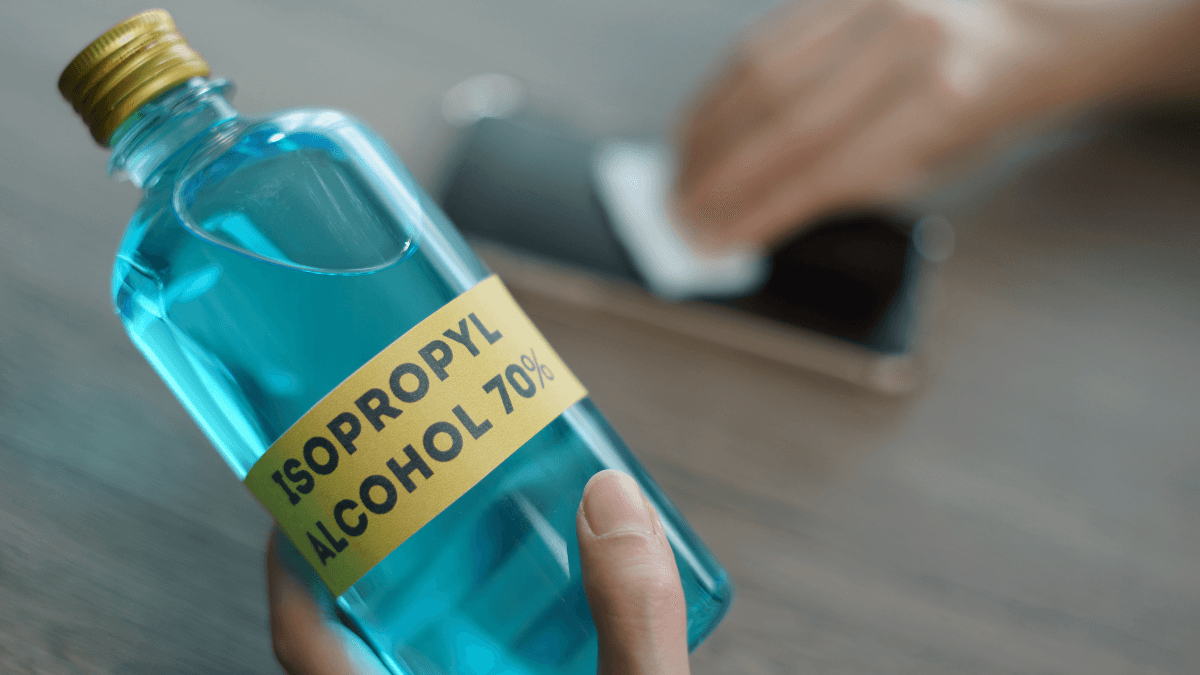
Isopropyl alcohol structure describes a three-carbon secondary alcohol with the hydroxyl group on the middle carbon. Its molecular formula is C3H8O, and its condensed structural formula is often written as CH3-CH(OH)-CH3 or (CH3)2CHOH. That layout explains many familiar properties, including its polarity, water mixing, quick evaporation, and flammability.
This matters because structure is not just a classroom detail. It helps explain why isopropyl alcohol can act as a solvent, why it appears in rubbing alcohol products, and why labels emphasize ventilation, flame safety, and external use only.
Key Takeaways
- Isopropyl alcohol is propan-2-ol, a secondary alcohol.
- Its formula is C3H8O, but formula alone does not show atom arrangement.
- The hydroxyl group makes the molecule polar and able to hydrogen bond.
- Its carbon chain adds solvent power for some oils and residues.
- It is flammable and should never be swallowed or mixed with cleaners.
Why Isopropyl Alcohol Structure Matters
The central feature is the hydroxyl group, written as -OH. In isopropyl alcohol, that -OH group attaches to the middle carbon of a three-carbon chain. Chemists call this a secondary alcohol because the carbon bearing the -OH group is bonded to two other carbon atoms.
That small placement change matters. A hydroxyl group gives alcohols many of their shared traits, such as hydrogen bonding and water solubility. The three-carbon skeleton adds a small nonpolar region, which helps the liquid interact with some greasy or oily residues. Together, these features make isopropyl alcohol useful as a solvent in homes, laboratories, and industrial settings.
Knowing the isopropyl alcohol structure also helps prevent name confusion. Isopropyl alcohol, isopropanol, 2-propanol, and propan-2-ol usually refer to the same chemical substance. Rubbing alcohol is different: it is a consumer product that may contain isopropyl alcohol mixed with water and sometimes other ingredients.
From C3H8O to a Structural Formula
The molecular formula C3H8O tells you the atom count: three carbon atoms, eight hydrogen atoms, and one oxygen atom. It does not tell you how those atoms connect. That is why structural formulas matter.
A common structural formula is CH3-CH(OH)-CH3. The two CH3 groups are methyl groups on either side of the middle carbon. The middle carbon carries one hydrogen and the hydroxyl group. This arrangement is also written as (CH3)2CHOH, which shows two methyl groups attached to the same carbon that carries -OH.
| Term | Meaning |
|---|---|
| Molecular formula | C3H8O; the total number of each atom. |
| Condensed formula | CH3-CH(OH)-CH3 or (CH3)2CHOH; a compact structure. |
| IUPAC name | Propan-2-ol; the -OH group is on carbon 2. |
| Functional group | Alcohol hydroxyl group, written as -OH. |
| Molecular weight | About 60.10 g/mol for pure isopropyl alcohol. |
Formula alone can mislead because C3H8O has structural isomers. Propan-1-ol has the same molecular formula, but its -OH group is on the end carbon. Methoxyethane, an ether, also has the same formula but a different functional group. Same formula, different connectivity, different behavior.
Polarity, Hydrogen Bonding, and Water Mixing
Isopropyl alcohol is polar overall. Oxygen pulls electron density toward itself, creating polar O-H and C-O bonds. The molecule can also form hydrogen bonds, which are attractions involving hydrogen attached to an electronegative atom such as oxygen.
That polarity helps explain why isopropyl alcohol mixes well with water. Water is also polar and forms hydrogen bonds. When the two liquids mix, their molecules can interact instead of separating into obvious layers.
The molecule is not simply water-like, though. Its two methyl groups are nonpolar compared with the hydroxyl end. This split personality helps it interact with both water and some organic residues. That is one reason it can remove certain oils, marker residues, or sticky films better than water alone.
Why it matters: A molecule can be polar and still have nonpolar regions that shape its behavior.
Polarity also influences evaporation and skin feel. Isopropyl alcohol often feels cool on skin because it evaporates readily, carrying heat away as it changes from liquid to vapor. That sensation does not make it harmless. Repeated or heavy skin exposure can be drying or irritating, and vapor exposure can bother the eyes, nose, or throat.
Physical Properties That Follow From the Molecule
Pure isopropyl alcohol is a colorless, volatile liquid with a strong odor. Volatile means it forms vapor easily. Its boiling point is about 82.6 degrees Celsius, lower than water but higher than many small hydrocarbons. Its density is about 0.785 g/mL near room temperature, so pure isopropyl alcohol is less dense than water.
These values help explain everyday observations. A spill can evaporate faster than a similar amount of water. A closed container matters because vapors can build up. Flame safety also matters because isopropyl alcohol is flammable, and its vapor can ignite near sparks, pilot lights, cigarettes, or hot surfaces.
Concentration changes the picture. A bottle labeled as rubbing alcohol usually contains water plus isopropyl alcohol, so its density, evaporation speed, odor, and cleaning behavior may differ from the pure chemical. Product labels are the best source for the exact concentration and intended use.
Temperature also affects measurements. Density changes with temperature, and evaporation depends on airflow, surface area, and room conditions. If you are comparing data from different references, check whether the values refer to pure isopropyl alcohol or a diluted product.
How It Compares With Ethanol
Ethanol and isopropyl alcohol are both small alcohols, but their structures are not the same. Ethanol has two carbons and is a primary alcohol, with the formula CH3CH2OH. Isopropyl alcohol has three carbons and is a secondary alcohol, with the -OH group on the middle carbon.
The isopropyl alcohol structure differs enough to change important properties. Isopropyl alcohol has a slightly larger nonpolar carbon portion than ethanol. That can affect solvent behavior, odor, evaporation, and how the liquid interacts with residues. Both substances are flammable, and both need careful handling.
They are not interchangeable just because both are alcohols. Ethanol is the alcohol found in alcoholic beverages when produced for that purpose. Isopropyl alcohol is not beverage alcohol and is unsafe to drink. Products may also contain denaturants, water, fragrances, or other ingredients that change safe use.
If a product, device, or care instruction names one alcohol, follow that instruction. Substituting another solvent can damage surfaces, reduce intended performance, or create avoidable exposure risks.
Uses and Safety Signals on a Label
Isopropyl alcohol appears in many settings because it combines water mixing, organic solvent behavior, and quick evaporation. It may be used in rubbing alcohol products, surface preparation, electronics cleaning, laboratory work, and manufacturing. The right use depends on the product concentration, ingredients, surface, and label directions.
For household use, labels deserve more attention than the chemical name alone. A rubbing alcohol bottle is not the same as a lab-grade solvent. A disinfecting product may have a specific contact time, surface direction, or warning statement. A screen cleaner or device-cleaning instruction may limit which solvents are safe.
Quick tip: Read the full label before using alcohol on skin, devices, or coated surfaces.
Safety warnings usually reflect real chemical hazards. Keep isopropyl alcohol away from flames and heat. Use it with good ventilation. Store it tightly closed and out of reach of children. Do not swallow it, inhale vapors intentionally, or use it as a treatment for fever or internal symptoms.
Do not mix it with bleach, ammonia products, acids, or other cleaners unless a product label specifically tells you to do so. Mixing household chemicals can create irritating or dangerous vapors. If someone swallows isopropyl alcohol, has trouble breathing, becomes very drowsy, or develops serious eye or skin symptoms after exposure, seek urgent medical or poison-control guidance.
Common Naming and Formula Traps
One common trap is treating C3H8O as a complete identity. It is a molecular formula, not a full structure. Several different compounds can share that formula. The structural formula tells you which atoms connect and where the functional group sits.
Another trap is assuming every product called alcohol behaves the same way. Ethanol, methanol, propan-1-ol, and isopropyl alcohol are distinct chemicals. Methanol is especially dangerous and should not be substituted for isopropyl alcohol in consumer settings. Even within isopropyl alcohol products, concentration and added ingredients matter.
People also confuse pure isopropyl alcohol with rubbing alcohol. Rubbing alcohol usually means a diluted product intended for external use. It may include water and other ingredients. The safest interpretation comes from the specific product label, not from the common name.
Finally, polar does not mean nonflammable. Isopropyl alcohol can mix with water and still burn. This is why storage and ventilation instructions matter even when the bottle is partly water.
Authoritative Sources
The references below support formula, naming, property, and safety details used in this overview.
- PubChem Compound Summary for molecular formula, synonyms, molecular weight, and identifiers.
- American Chemical Society overview for chemical identity and common chemistry context.
- NIOSH Pocket Guide for occupational hazard and flammability information.
If you enjoy science-based health context, you can browse the Research Category for more educational reading.
This content is for informational purposes only and is not a substitute for professional medical advice.


