
Please note: a valid prescription is required for all prescription medication.
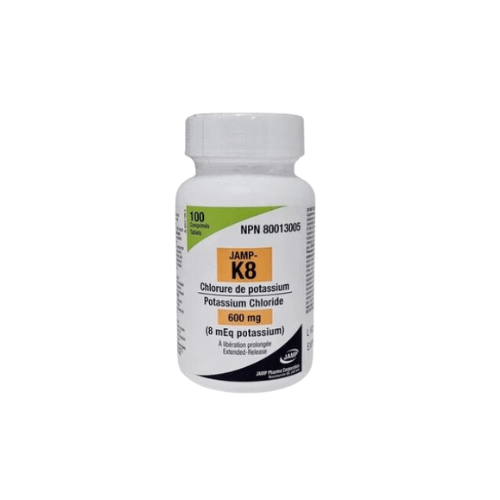
Potassium Chloride (K8)(8 mEq)
Buy Potassium Chloride K8 Online
Secure Encrypted Payments
Potassium Chloride K8 is an 8 mEq potassium chloride product used to replace potassium when levels are low or at risk of becoming low. You can buy Potassium Chloride K8 online, view the current Potassium Chloride 8 mEq price, and choose the strength and quantity that match your clinician’s directions. This medicine should be used with appropriate lab monitoring because both low and high potassium can affect muscle function and heart rhythm.
Potassium is an essential electrolyte, meaning a charged mineral that helps nerves, muscles, kidneys, and the heart work normally. Potassium Chloride (K8)(8 mEq) is commonly associated with 600 mg potassium chloride providing 8 mEq of potassium for this strength. Always match the 8 mEq strength, release form, and tablet quantity to the directions you were given rather than choosing a dose on your own.
Potassium Chloride K8 Price and Strength Details
Potassium Chloride K8 price depends on the strength and quantity shown during ordering. Start with the active ingredient and strength: Potassium Chloride 8 mEq tablets are different from higher-strength potassium products and from other potassium salts. If more than one quantity is offered, compare the total number of tablets with the total amount due, not only the bottle wording.
The 8 mEq strength may also be described as Potassium Chloride 600 mg tablets when the label uses the 600 mg potassium chloride to 8 mEq potassium equivalence. That conversion is useful for matching labels, but it should not be applied automatically to every potassium product. Potassium citrate, potassium bicarbonate, liquids, powders, capsules, and extended-release tablets may have different release characteristics or clinical purposes.
Quick tip: Match the mEq strength first, then compare tablet count and total cost.
| Ordering detail | What to verify |
|---|---|
| Active ingredient | Potassium chloride, not a different potassium salt. |
| Strength | 8 mEq, also commonly shown as 600 mg for this product strength. |
| Release form | Use the form directed for you, especially if extended-release wording appears. |
| Quantity | Compare total tablets supplied with the amount you need. |
| Directions | Follow the label and clinician instructions for timing and frequency. |
Cash-pay customers should look at the current Potassium Chloride K8 cost, quantity, and any order notes before checkout. Similar names can cause mistakes, so avoid substituting another strength, salt, or release type unless your clinician changes the plan.
How to Order Potassium Chloride K8 Online
To order Potassium Chloride K8 online, choose the 8 mEq strength and quantity that correspond to your written directions. BorderFreeHealth works with licensed Canadian pharmacy channels for U.S. customers seeking cash-pay access, and US delivery from Canada may fit people who want a cross-border ordering route. Keep the medication name, strength, and dosage directions available so the pharmacy can help avoid mismatches.
Before completing checkout, compare the product name, 8 mEq strength, 600 mg wording if shown, release form, and quantity. This step is especially important for potassium because products that look similar can release potassium differently or supply a different amount per dose.
If order information mentions prompt, express shipping, read it together with the handling and processing information shown at checkout. Shipping language should never be used to delay urgent care, skip lab monitoring, or change how you take potassium chloride.
What Potassium Chloride 8 mEq Is Used For
Potassium chloride for hypokalemia is used to treat or help prevent low potassium in the blood. Hypokalemia can develop when the body loses potassium or shifts potassium out of the bloodstream. Common causes include certain diuretics, vomiting, diarrhea, reduced intake, and medical conditions that affect fluid or electrolyte balance.
A clinician may order potassium chloride after reviewing blood tests, kidney function, other medicines, and symptoms. Low potassium may cause muscle weakness, cramps, fatigue, constipation, palpitations, or abnormal heart rhythm, although some people have no obvious symptoms. The goal is to restore potassium safely without pushing levels too high.
Prescription-strength potassium replacement is different from choosing a general wellness supplement. It involves a specific strength, form, and monitoring plan. The Low Potassium Hypokalemia category can help you browse related treatment options while keeping your lab results and clinician guidance central.
How 600 mg Relates to 8 mEq
Many people ask how many milligrams are in Potassium Chloride 8 mEq. For this product strength, 600 mg of potassium chloride is commonly described as equivalent to 8 mEq of potassium. The milligram amount refers to potassium chloride content, while mEq describes the electrolyte amount supplied.
This relationship helps when labels, pharmacy records, or directions use different unit wording. Potassium Chloride K8 8 mEq, Potassium Chloride 8 mEq 600 mg, and K8 potassium chloride tablets may refer to the same strength when the product label supports that equivalence. Do not assume the same conversion for 750 mg products, liquids, powders, or other potassium salts.
Klor-Con 8 generic language may appear in drug references because potassium chloride 8 mEq is the active ingredient and strength used in some branded and generic products. Brand names, market status, and substitution rules can vary by country and pharmacy. The practical buying decision is to match the active ingredient, 8 mEq strength, and release form to your directions.
Administration Details to Confirm
Potassium Chloride 8 mEq dosage should come from your clinician. Use the product strength to match directions, then follow the label for how often to take it. Do not increase, decrease, or double doses because potassium levels can change quickly in people with kidney problems, dehydration, medication changes, or acute illness.
Extended-release potassium chloride tablets are generally intended to release potassium gradually. When a product is extended-release, tablets should usually be swallowed whole and not crushed, chewed, or sucked unless the label specifically allows another method. Altering the tablet can change release and may raise the risk of stomach or esophageal irritation.
- Food and fluids: follow label directions about taking tablets with meals and water.
- Swallowing: ask for help if tablets stick or are difficult to swallow.
- Missed dose: follow your care team’s instructions rather than doubling up.
- Lab monitoring: keep scheduled potassium and kidney function tests.
- Medication changes: report new diuretics, blood pressure drugs, or supplements.
Some people need a different formulation if solid tablets cause swallowing problems or stomach irritation. Contact a clinician or pharmacist if you have persistent abdominal pain, reflux symptoms, vomiting, or trouble swallowing after taking potassium chloride.
Side Effects, Warnings, and Monitoring
Common potassium chloride side effects can include nausea, vomiting, diarrhea, gas, and stomach discomfort. Taking the medicine with food and plenty of liquid, when directed, may reduce irritation. Side effects that persist, worsen, or interfere with eating and drinking should be discussed promptly.
The most serious risk is hyperkalemia, which means too much potassium in the blood. High potassium can cause unusual weakness, numbness or tingling, confusion, chest discomfort, fainting, or a fast, slow, or irregular heartbeat. Severe hyperkalemia can be dangerous because potassium helps regulate electrical signaling in the heart.
Why it matters: Potassium affects heart rhythm, so blood tests are part of safe use.
Solid oral potassium products can also irritate or injure the gastrointestinal tract in certain situations. Risk may be higher if tablets move slowly through the esophagus, stomach, or intestines. People with swallowing disorders, esophageal narrowing, severe delayed stomach emptying, bowel narrowing, or medicines that slow gut movement should ask which formulation is safest.
Seek urgent medical help for severe abdominal pain, persistent vomiting, black or bloody stools, chest pain, severe weakness, fainting, confusion, or an irregular heartbeat. These symptoms may signal serious gastrointestinal injury or a potassium imbalance that needs immediate evaluation.
Interactions and Health Conditions to Discuss
Potassium chloride can interact with medicines that raise potassium or reduce potassium excretion. Important examples include ACE inhibitors, ARBs, potassium-sparing diuretics, trimethoprim, heparin, cyclosporine, tacrolimus, and some NSAIDs. Potassium-containing salt substitutes and electrolyte powders can also add to the total potassium load.
Kidney disease is one of the most important safety considerations because the kidneys remove excess potassium. Dehydration, uncontrolled diabetes, adrenal problems, serious burns, tissue injury, and sudden changes in fluid balance can also affect potassium levels. Your clinician may monitor blood potassium, kidney function, and sometimes heart rhythm depending on your health history.
Do not combine Potassium Chloride K8 with other potassium supplements unless your care team says the combination fits your plan. Even non-prescription products can become risky when taken with potassium chloride tablets, blood pressure medicines, or potassium-sparing diuretics.
Storage, Handling, and Travel
Store Potassium Chloride 8 mEq tablets according to the package label, usually in a dry place at controlled room temperature. Keep the container tightly closed and protect tablets from excess moisture. Store all potassium products out of reach of children and pets.
Keep tablets in their original labeled container when possible. The label helps you identify the active ingredient, strength, directions, expiration date, and pharmacy contact information. This is useful during travel, clinic visits, medication reviews, or emergencies.
When your order arrives, inspect the name, strength, tablet count, and directions before taking a dose. If the bottle, units, release form, or instructions differ from what you expected, ask for clarification. Do not use damaged tablets or a product that cannot be clearly identified.
Related Potassium and Fluid Balance Products
Potassium chloride extended release tablets are not interchangeable with every potassium product. Potassium citrate is a different salt that may be used for different urinary chemistry needs. If your directions specifically name potassium citrate, the K-Citra Potassium Citrate 10 mEq product may be relevant to discuss with your clinician.
Some fluid and blood pressure medicines affect potassium levels. A loop diuretic such as Furosemide can lower potassium in some people, which is one reason clinicians may monitor electrolytes. It is not a substitute for potassium chloride and should only be used for its intended indication.
If you want to browse broader medication categories, the Other medicines category includes additional products that may be part of a broader care plan. Country-of-origin information can also be reviewed through Canada-sourced products when that sourcing detail matters for your order.
Authoritative Sources
Medication information on potassium chloride is supported by regulator-backed references. The FDA label details for potassium chloride extended-release tablets describe uses, administration precautions, contraindications, gastrointestinal warnings, and monitoring concerns.
The Canadian product monograph for slow-release potassium chloride supports the 600 mg to 8 mEq equivalence and provides additional safety information for slow-release solid oral potassium products.
This content is for informational purposes only and is not a substitute for professional medical advice.
eGFR Calculator
Estimate kidney filtration using the 2021 CKD-EPI creatinine equation.
eGFR
-
mL/min/1.73 m2
G category
-
requires clinical context
These calculations are for education only and do not replace clinical advice, diagnosis, or treatment. Always confirm medical decisions with a qualified healthcare professional.
Creatinine Clearance Calculator
Estimate creatinine clearance using the Cockcroft-Gault equation.
CrCl
-
mL/min estimate
These calculations are for education only and do not replace clinical advice, diagnosis, or treatment. Always confirm medical decisions with a qualified healthcare professional.
Anion Gap Calculator
Calculate anion gap from sodium, chloride, and bicarbonate, with optional albumin correction.
Anion gap
-
Na - (Cl + HCO3)
Albumin corrected
-
adds 2.5 per 1 g/dL below 4.0
These calculations are for education only and do not replace clinical advice, diagnosis, or treatment. Always confirm medical decisions with a qualified healthcare professional.
Serum Osmolality Calculator
Estimate calculated serum osmolality from sodium, glucose, and BUN or urea.
Calculated osmolality
-
mOsm/kg
These calculations are for education only and do not replace clinical advice, diagnosis, or treatment. Always confirm medical decisions with a qualified healthcare professional.
Corrected Sodium Calculator
Estimate sodium corrected for hyperglycemia using common 1.6 and 2.4 correction factors.
Corrected sodium
-
1.6 factor
Corrected sodium
-
2.4 factor
These calculations are for education only and do not replace clinical advice, diagnosis, or treatment. Always confirm medical decisions with a qualified healthcare professional.
Express Shipping - from $29.99
Shipping with this method takes 3-5 days
Prices:
- Dry-Packed Products $29.99
- Cold-Packed Products $39.99
Shipping Countries:
- United States (all contiguous states**)
- Worldwide (excludes some countries***)
Standard Shipping - $19.99
Shipping with this method takes 5-10 days
Prices:
- Dry-Packed Products $19.99
- Not available for Cold-Packed products
Shipping Countries:
- United States (all contiguous states**)
- Worldwide (excludes some countries***)
What is Potassium Chloride 8 mEq used for?
Potassium Chloride 8 mEq is used to treat or help prevent low potassium in the blood, also called hypokalemia. Clinicians may use it when lab results, medicines, or medical conditions show that potassium replacement is needed.
How many mg is 8 mEq potassium chloride?
For this Potassium Chloride K8 strength, 600 mg of potassium chloride is commonly equivalent to 8 mEq of potassium. Do not apply that conversion to every potassium product unless the label supports it.
What are the worst side effects of potassium chloride?
Serious concerns include high potassium levels, irregular heartbeat, severe weakness, confusion, chest pain, and gastrointestinal injury such as severe abdominal pain or black or bloody stools. Seek urgent medical help if these occur.
Can Potassium Chloride K8 interact with other medicines?
Yes. Interactions can involve ACE inhibitors, ARBs, potassium-sparing diuretics, NSAIDs, trimethoprim, heparin, cyclosporine, tacrolimus, salt substitutes, and other potassium supplements. Share your full medication list with your care team.
Should Potassium Chloride ER 8 mEq tablets be crushed?
Extended-release potassium chloride tablets should generally be swallowed whole unless the label gives different instructions. Crushing, chewing, or sucking an extended-release tablet can change release and increase irritation risk.
Rewards Program
Earn points on birthdays, product orders, reviews, friend referrals, and more! Enjoy your medication at unparalleled discounts while reaping rewards for every step you take with us.
You can read more about rewards here.
POINT VALUE
How to earn points
- 1Create an account and start earning.
- 2Earn points every time you shop or perform certain actions.
- 3Redeem points for exclusive discounts.
You Might Also Like
Select options
This product has multiple variants. The options may be chosen on the product page
Select options
This product has multiple variants. The options may be chosen on the product page
Select options
This product has multiple variants. The options may be chosen on the product page
Select options
This product has multiple variants. The options may be chosen on the product page