
Please note: a valid prescription is required for all prescription medication.
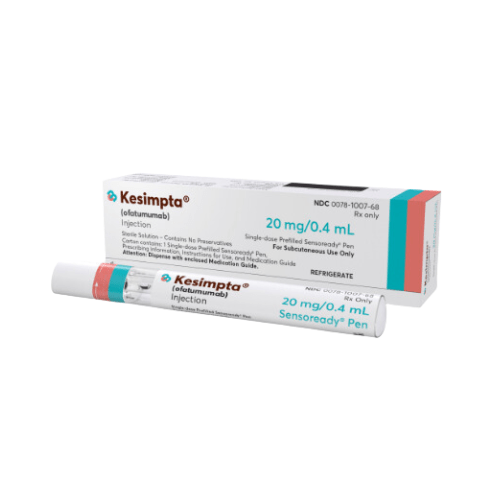
Kesimpta
Buy Kesimpta Online
Secure Encrypted Payments
Kesimpta is an ofatumumab injection used for adults with relapsing forms of multiple sclerosis. You can buy Kesimpta online, view the current Kesimpta price during ordering, and choose the dose or strength shown that matches your clinician’s directions. BorderFreeHealth offers US delivery from Canada for eligible medication orders supplied through licensed pharmacies.
Kesimpta Price and Dose Selection
Kesimpta cost can vary with the quantity ordered, the pharmacy supply route, and whether you pay out of pocket. The checkout process shows the current cash price before you place an order, so you can plan around your monthly treatment schedule and any insurance or self-pay considerations.
Match the strength, device, and quantity to the directions from your healthcare professional. Current product information commonly describes Kesimpta 20 mg/0.4 mL as a subcutaneous injection supplied as a single-dose Sensoready pen or prefilled syringe. Do not change device type, dose timing, or injection plan without clinical guidance.
Quick tip: Keep your dosing calendar nearby when choosing quantity, because starter doses and monthly maintenance doses use different timing.
How Ordering Works
Order Kesimpta by selecting the available strength and quantity, then follow the checkout steps. Our team may review order information and medication directions for completeness before the pharmacy supplies the medicine. If the pharmacy needs clarification, it may request additional documentation before release.
Cold-chain medicines need careful handling from pharmacy storage through patient use. When required, temperature-sensitive handling is used during logistics, and prompt, express shipping may be available for qualifying orders. Plan refills early so a refrigerator-dependent therapy is not interrupted by travel, weather, or documentation delays.
Customers who are comparing neurology treatments can browse the Neurology category for related pharmacy items. For condition-focused browsing, the relapsing multiple sclerosis section groups products connected with RMS care.
What Kesimpta Is Used For
Kesimpta is used to treat adults with relapsing forms of multiple sclerosis, including clinically isolated syndrome, relapsing-remitting disease, and active secondary progressive disease. Relapsing MS involves episodes of new or worsening neurologic symptoms followed by periods of partial or complete recovery. Treatment decisions depend on MS subtype, disease activity, prior therapies, infection history, vaccination timing, and monitoring needs.
Kesimpta is not used as a general symptom medicine for fatigue, pain, stiffness, or walking problems. It is a disease-modifying therapy, meaning it is intended to reduce inflammatory disease activity over time rather than treat an acute relapse once symptoms start. Acute relapses may require a separate clinical plan.
People often ask whether Kesimpta is the best MS drug. There is no single best disease-modifying therapy for everyone. A clinician weighs treatment goals, safety risks, route of administration, lab monitoring, pregnancy plans, infection risk, and patient preference before choosing among injectable, oral, and infusion options.
How Ofatumumab Works
Kesimpta contains ofatumumab, a monoclonal antibody that targets CD20, a marker found on certain B cells. B cells are immune cells that can contribute to inflammation in relapsing MS. By reducing these cells, ofatumumab can lower immune activity involved in MS relapses and new inflammatory lesions.
This mechanism is different from older self-injected MS medicines such as glatiramer acetate and from oral sphingosine-1-phosphate modulators. Because it affects immune function, Kesimpta requires attention to infection symptoms, vaccination timing, and periodic monitoring. The B-cell effect is also why missed doses and treatment interruptions should be discussed with a healthcare professional rather than handled casually.
Dosing and Injection Basics
Standard labeling describes 20 mg injections given at week 0, week 1, and week 2, followed by monthly dosing starting at week 4. The medicine is injected under the skin of the abdomen, thigh, or outer upper arm. Rotate injection sites and avoid skin that is tender, bruised, red, scaly, or hard.
Kesimpta is designed for at-home use after training. Before injecting, allow the pen or prefilled syringe to reach room temperature for the time described in the Instructions for Use. Inspect the liquid before use, wash your hands, clean the injection area with alcohol, and use the device only once.
If a dose is missed, official labeling generally instructs patients to take it as soon as possible and then continue monthly dosing from the new date. If you are unsure whether timing needs adjustment, ask your healthcare professional before taking an extra or delayed dose.
Forms, Strengths, and Device Handling
Kesimpta 20 mg injection is commonly supplied as Kesimpta 20 mg/0.4 mL in a prefilled autoinjector or prefilled syringe. The Kesimpta pen 20 mg is intended to simplify self-injection after training, while the prefilled syringe may be used when that device is selected as part of the treatment plan. Availability of a specific device can depend on pharmacy supply.
Do not reuse a pen or syringe, do not share injection devices, and do not attempt to recap needles. Place each used device into a puncture-resistant sharps container immediately after injection. Follow local rules for disposal when the container is nearly full.
Why it matters: Single-use injection devices reduce accidental needle exposure and help maintain consistent medication delivery.
Storage, Refrigeration, and Travel
Store Kesimpta in the refrigerator in the original carton to protect it from light. Do not freeze it, and do not shake the device. If a pen or syringe has been exposed to conditions outside the labeled storage instructions, ask a pharmacist or healthcare professional before using it.
Travel requires planning because this medicine is temperature sensitive. Carry the carton, the device instructions, and medication documentation in your hand luggage when flying. Use an insulated bag and cooling materials if instructed, but avoid direct contact between the device and ice packs.
Country-of-origin browsing is available through the Canada product attribute section. For MS education and related neurology articles, the neurology articles category may help you prepare questions for your healthcare team.
Side Effects, Warnings, and Monitoring
Common Kesimpta side effects include injection-site reactions such as redness, pain, itching, or swelling. Some people report headache, fatigue, upper respiratory symptoms, sore throat, runny nose, or urinary tract infection symptoms. Injection reactions are often more noticeable with early doses, but new or worsening symptoms still deserve attention.
Serious risks include infections, lower immunoglobulin levels, hepatitis B reactivation, and hypersensitivity reactions. People with active hepatitis B infection should not use ofatumumab. Screening for hepatitis B is recommended before starting, and clinicians may monitor immunoglobulin levels during treatment, especially if infections occur repeatedly.
Progressive multifocal leukoencephalopathy, a rare brain infection, has been reported with some medicines that affect the immune system. Contact a healthcare professional promptly for new weakness, vision changes, confusion, speech problems, balance changes, fever, shingles, persistent cough, painful urination, or any infection that does not improve.
Live or live-attenuated vaccines are generally avoided during treatment and for a period after stopping until B-cell recovery is adequate. Vaccination plans should be reviewed before therapy begins. Tell your healthcare professional about all medicines, supplements, immune-suppressing treatments, and recent vaccines, because combining immune effects can increase infection risk.
Pregnancy planning and breastfeeding need individualized discussion. Ofatumumab affects immune cells, and infant vaccination timing may matter after exposure during pregnancy. Do not start, stop, or restart therapy based only on general product information.
Weight, Fatigue, and Day-to-Day Expectations
Weight gain is not usually listed among the most common Kesimpta side effects in patient-facing summaries, but body weight can change for many reasons during MS care. Reduced activity during relapses, steroid treatment for acute attacks, mood changes, sleep disruption, and other medicines may all contribute. Report unexplained or rapid weight changes so other causes can be assessed.
Fatigue is common in MS and may also occur around infections or injection reactions. Track fatigue patterns, dose dates, infections, sleep, and other medication changes. A simple symptom log can help your clinician decide whether symptoms relate to MS activity, Kesimpta tolerability, or another health issue.
Many patients value that maintenance dosing is monthly after the starter phase. Still, convenience does not remove the need for routine follow-up. Imaging, lab checks, infection history, and relapse symptoms help determine whether the medicine remains appropriate over time.
How It Compares With Other MS Therapies
Relapsing MS treatments differ by mechanism, route, monitoring needs, and safety profile. Kesimpta is a self-administered anti-CD20 B-cell therapy. Other anti-CD20 medicines may be given by infusion, while some disease-modifying therapies are oral tablets or other injections. The right choice depends on disease activity and personal risk factors.
People who prefer tablets may ask about oral disease-modifying therapy, while others may prefer an injection schedule that fits home routines. Safety tradeoffs also matter: some medicines require heart-rate observation, eye exams, liver monitoring, blood-count monitoring, or special infection screening. A clinician can place Kesimpta’s benefits and risks beside those alternatives.
If you switch from another MS therapy, timing matters because overlapping immune effects can increase infection risk, while long gaps may allow disease activity to return. Do not combine or transition disease-modifying therapies without a coordinated plan.
Questions to Ask Before Starting or Refilling
- Is my MS subtype a relapsing form for which ofatumumab is appropriate?
- Which device should I use: prefilled autoinjector or prefilled syringe?
- What hepatitis B testing or immunoglobulin monitoring do I need?
- Which vaccines should be completed before treatment?
- What infection symptoms should prompt a same-day call?
- How should I handle a missed monthly dose?
- What storage plan should I use for travel or power outages?
- How far ahead should I request refills for a refrigerated medicine?
Authoritative Sources
Official prescribing information
This content is for informational purposes only and is not a substitute for professional medical advice.
Express Shipping - from $29.99
Shipping with this method takes 3-5 days
Prices:
- Dry-Packed Products $29.99
- Cold-Packed Products $39.99
Shipping Countries:
- United States (all contiguous states**)
- Worldwide (excludes some countries***)
Standard Shipping - $19.99
Shipping with this method takes 5-10 days
Prices:
- Dry-Packed Products $19.99
- Not available for Cold-Packed products
Shipping Countries:
- United States (all contiguous states**)
- Worldwide (excludes some countries***)
What is Kesimpta used for?
Kesimpta is used for adults with relapsing forms of multiple sclerosis, including clinically isolated syndrome, relapsing-remitting MS, and active secondary progressive MS. It is a disease-modifying therapy, not a medicine for immediate relief of an acute relapse.
How is Kesimpta usually taken?
Labeling describes 20 mg injections at week 0, week 1, and week 2, followed by monthly dosing starting at week 4. It is injected under the skin using the device and technique taught by a healthcare professional.
How much does Kesimpta cost?
Kesimpta price depends on the quantity, device supply, and pharmacy sourcing at the time of ordering. The current cash price is shown during checkout before you place an order.
Does Kesimpta cause weight gain?
Weight gain is not typically highlighted as one of the most common Kesimpta side effects. Weight changes can happen for other reasons during MS care, including activity changes, steroid use for relapses, sleep disruption, or other medicines, so unexplained changes should be discussed with a clinician.
What are common Kesimpta side effects?
Common side effects include injection-site redness, pain, itching, swelling, headache, fatigue, upper respiratory symptoms, and urinary tract infection symptoms. Serious infection symptoms, shingles, persistent fever, new neurologic changes, or signs of allergic reaction need prompt medical attention.
How should Kesimpta be stored?
Kesimpta should be stored in the refrigerator in its original carton and protected from light. Do not freeze or shake it. Follow the Instructions for Use and ask a pharmacist or healthcare professional if the device was exposed to temperatures outside labeled guidance.
Is Kesimpta the best MS drug?
No single MS therapy is best for everyone. A clinician considers MS subtype, relapse history, MRI activity, infection risk, vaccination timing, pregnancy plans, monitoring needs, and route preference before recommending Kesimpta or another disease-modifying therapy.
Rewards Program
Earn points on birthdays, product orders, reviews, friend referrals, and more! Enjoy your medication at unparalleled discounts while reaping rewards for every step you take with us.
You can read more about rewards here.
POINT VALUE
How to earn points
- 1Create an account and start earning.
- 2Earn points every time you shop or perform certain actions.
- 3Redeem points for exclusive discounts.
You Might Also Like
Select options
This product has multiple variants. The options may be chosen on the product page
Select options
This product has multiple variants. The options may be chosen on the product page
Select options
This product has multiple variants. The options may be chosen on the product page
Select options
This product has multiple variants. The options may be chosen on the product page