

Please note: a valid prescription is required for all prescription medication.
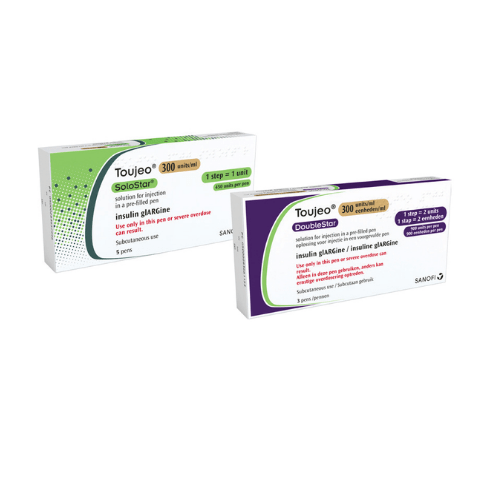
Toujeo Doublestar/Solostar Prefilled Pen
Buy Toujeo Doublestar/Solostar Prefilled Pen Online
Secure Encrypted Payments
Toujeo Doublestar/Solostar Prefilled Pen is a long-acting insulin glargine U-300 pen used to help improve blood sugar control in diabetes. It can be ordered online, with pen choices selected according to the strength and quantity shown during checkout and matched to your clinician’s directions. Border Free Health helps U.S. customers arrange US delivery from Canada through licensed pharmacy channels.
Toujeo Pen Price, Strength, and Ordering Details
Toujeo contains insulin glargine 300 units/mL, a concentrated basal insulin designed for once-daily background coverage. When reviewing Toujeo pen cost, confirm the exact pen format, quantity, and total units your treatment plan requires. The higher concentration means the same number of insulin units is delivered in a smaller liquid volume than U-100 insulin glargine.
The pen dial shows units, so dose conversion is not needed for routine use. Your daily unit amount and titration plan should come from your healthcare professional. If you are switching from another basal insulin, follow the transition plan you were given and monitor glucose closely during the first several weeks.
People paying out of pocket often look at Canadian cash-pay pricing because insulin costs can vary widely by pharmacy, pen size, and refill quantity. Choose the available pen presentation that aligns with your dose, expected days of use, and storage limits for opened pens. For broader browsing by treatment category, see our Diabetes Care selection.
DoubleStar vs SoloStar: Which Pen Format Fits Your Dose?
Toujeo SoloStar and Toujeo DoubleStar are prefilled pens made for Toujeo 300 units/mL insulin glargine. The main practical difference is capacity: SoloStar is the smaller pen presentation, while DoubleStar is a larger-capacity pen for people who need more insulin units per injection or per refill cycle. Both are designed so the dose is set in insulin units on the pen.
The Toujeo 1.5 mL SoloStar format may suit people whose daily basal dose fits comfortably within the smaller pen. The Toujeo 3 mL DoubleStar format may reduce how often some higher-dose users need to change pens. Your clinician and pharmacist can help align the pen size with your prescribed units, vision, hand strength, and injection technique.
Do not choose a larger pen only to change your insulin amount. The pen size affects capacity, not your individualized dose. If your dosing needs change, ask your care team how to adjust safely rather than estimating based on the amount left in the device.
What This Basal Insulin Treats
Toujeo is used to improve glycemic control in diabetes mellitus when basal insulin is appropriate. Basal insulin provides steady background insulin between meals and overnight. It may be used in type 1 diabetes as part of a regimen that also includes mealtime insulin, or in type 2 diabetes alone or with other diabetes medicines.
This medicine is not used for diabetic ketoacidosis, which requires urgent medical treatment. It should also not be used during an episode of low blood sugar. If fasting glucose remains high despite oral therapy, or if your current basal insulin does not fit your routine, your clinician may discuss whether insulin glargine U-300 is suitable.
For condition-specific background, visit our sections on type 1 diabetes and type 2 diabetes. These resources can help you prepare practical questions about monitoring, insulin timing, and long-term glucose goals.
How Toujeo Works in the Body
Insulin glargine U-300 is a long-acting insulin analog. After injection under the skin, it releases slowly to provide basal insulin activity over the day. This supports fasting and between-meal glucose control, but it does not replace rapid-acting insulin when mealtime coverage is needed.
Because Toujeo is concentrated at 300 units/mL, it delivers fewer milliliters of fluid for the same number of insulin units compared with U-100 glargine. That concentration can be useful for people prescribed larger basal doses, but it also makes correct pen use especially important. Always read the pen label before injecting, and never withdraw Toujeo from the pen with a syringe.
Blood sugar response can change when meal patterns, exercise, illness, kidney function, liver function, or other medicines change. Keep a glucose log during starts, switches, travel, and routine disruptions so your clinician can make dose decisions from real readings.
How to Use the Prefilled Pen Safely
Inject Toujeo under the skin once daily at the same time each day, or as directed by your care team. Common injection areas include the abdomen, thigh, or upper arm. Rotate within the chosen area to reduce skin thickening, pitting, or lumps that can interfere with insulin absorption.
Attach a new needle for each injection. Prime the pen as instructed before use so insulin flows properly. Dial the prescribed number of units, insert the needle under the skin, press the injection button fully, and hold the needle in place for the recommended time before removing it.
- Use the pen for one person only, even if the needle is changed.
- Do not mix Toujeo with other insulin products.
- Do not use Toujeo in an insulin pump.
- Do not inject into skin that is bruised, tender, scarred, or unusually thickened.
- Keep spare needles, glucose monitoring supplies, and low-glucose treatment available.
Quick tip: Record the date you first use a pen so you know when it should be discarded according to the label.
How Long a Pen Lasts
The number of days a Toujeo pen lasts depends on the total units in the pen and your prescribed daily units. A higher daily dose uses the pen faster, while a lower daily dose makes it last longer. The in-use storage limit can also determine when a pen must be discarded, even if insulin remains.
To estimate refill timing, divide the total units in your pen by your usual daily units, then account for priming and any dose changes. Do not stretch a pen beyond its labeled in-use period. If your dose is being titrated, plan refills conservatively so you are not left without basal insulin.
If the plunger position, remaining insulin, or dose window does not seem to match your expected supply, contact your pharmacist or clinician before using extra doses. Device problems, missed priming, or changed insulin needs can all affect how quickly a pen is used.
Storage, Travel, and Cold-Chain Handling
Keep unopened Toujeo pens refrigerated until the expiration date on the carton. Do not freeze the pen, and do not use it if it has been frozen. Once in use, store the pen as directed on the official label, away from direct heat, sunlight, children, and pets.
Before each injection, look at the solution. It should be clear and colorless, with no particles. Do not use a pen that looks cloudy, discolored, cracked, damaged, or exposed to storage conditions outside label instructions.
During travel, carry insulin and supplies in hand luggage with a copy of your medication directions. Avoid leaving pens in checked baggage, a parked car, or near cooling packs that could freeze the medicine. Orders may use prompt, express shipping when appropriate for handling requirements.
Side Effects, Warnings, and Monitoring
Low blood sugar is the most important safety concern with insulin. Symptoms may include shakiness, sweating, fast heartbeat, hunger, headache, mood changes, confusion, blurred vision, or weakness. Severe hypoglycemia can cause seizures, loss of consciousness, or injury and requires urgent treatment.
Other possible side effects include injection site redness, itching, swelling, lipodystrophy, weight gain, swelling from fluid retention, rash, or allergic reactions. Seek medical help right away for trouble breathing, widespread rash, swelling of the face or throat, or symptoms of severe low blood sugar that do not improve with treatment.
Tell your care team about all medicines, supplements, alcohol use, and major lifestyle changes. Other diabetes medicines can increase low-glucose risk. Beta-blockers may hide some warning signs of hypoglycemia. Thiazolidinediones can increase fluid retention when used with insulin. Illness, kidney disease, liver disease, missed meals, and increased activity can also change insulin needs.
Monitor glucose as directed, especially after starting Toujeo, changing from another insulin, traveling, or adjusting food and activity patterns. Do not drive or operate machinery if you feel symptoms of low blood sugar or if your readings are unsafe.
Missed Dose and Timing Questions
If you miss a Toujeo dose, follow the plan your clinician provided. Do not take two doses at once to make up for a missed injection. Because basal insulin works over many hours, doubling can increase the risk of low blood sugar later.
A consistent daily injection time helps reduce missed or duplicated doses. If your work schedule, sleep pattern, or travel plans make timing difficult, ask your care team how to shift injection time safely. Written reminders, phone alarms, and a simple dose log can prevent confusion.
Contact your clinician if you miss more than one dose, have repeated high readings, or are unsure whether a dose was delivered. Keep rapid sources of glucose available and know when to seek urgent care for very high glucose, ketones, vomiting, dehydration, or symptoms of diabetic ketoacidosis.
Comparing Toujeo With Other Diabetes Options
Toujeo is a concentrated long-acting insulin glargine product. It differs from shorter-acting mealtime insulin because it is intended for background coverage rather than controlling a single meal. It also differs from U-100 glargine because it uses 300 units/mL concentration and may have different titration needs after switching.
Some people with type 2 diabetes use non-insulin medicines along with basal insulin. Others may require mealtime insulin or a different basal option depending on glucose patterns, kidney function, hypoglycemia history, weight goals, and coverage needs. Your clinician can explain whether a concentrated basal insulin, a U-100 basal insulin, or a combination approach is more appropriate.
For browsing by origin, see products associated with Canada. You can also explore our type 1 diabetes articles and type 2 diabetes articles for practical education on monitoring, medication routines, and questions to raise during appointments.
Questions to Ask Before Starting or Refilling
Insulin is highly individualized, so the best pen choice depends on your daily units, refill schedule, storage habits, and ability to use the device correctly. Ask your clinician or pharmacist to watch your injection technique if you are new to pens or if your readings do not match expected patterns.
- Which Toujeo pen format best fits my daily basal insulin dose?
- What fasting glucose range should I use for dose discussions?
- How should I handle missed doses, sick days, or travel days?
- Which symptoms mean I should treat low blood sugar immediately?
- Do any of my other medicines increase hypoglycemia or swelling risk?
- When should I discard an in-use pen?
- How soon should I request a refill if my dose is being adjusted?
Why it matters: A pen that matches your dose and technique can reduce waste, missed injections, and refill stress.
Authoritative Sources
Manufacturer Toujeo information
Toujeo DoubleStar summary of product characteristics
This content is for informational purposes only and is not a substitute for professional medical advice.
Blood Glucose Unit Converter
Convert glucose readings between mg/dL and mmol/L without changing the clinical value.
mg/dL
-
US reporting unit
mmol/L
-
International reporting unit
These calculations are for education only and do not replace clinical advice, diagnosis, or treatment. Always confirm medical decisions with a qualified healthcare professional.
HbA1c & eAG Calculator
Convert between HbA1c percentage and estimated average glucose using the ADAG relationship.
HbA1c
-
percentage
eAG mg/dL
-
estimated average glucose
eAG mmol/L
-
estimated average glucose
These calculations are for education only and do not replace clinical advice, diagnosis, or treatment. Always confirm medical decisions with a qualified healthcare professional.
CGM Time-in-Range Summary
Summarise CGM percentages across very low, low, in-range, high, and very high glucose bands.
Entered total
-
should equal 100%
Below range
-
very low plus low
Above range
-
high plus very high
Summary
-
common adult CGM targets vary by patient
These calculations are for education only and do not replace clinical advice, diagnosis, or treatment. Always confirm medical decisions with a qualified healthcare professional.
Carb Serving Calculator
Convert total carbohydrate grams into carb choices for meal planning and diabetes education.
Carb choices
-
total carbs divided by choice size
Rounded choices
-
nearest half choice
Carb calories
-
4 kcal per gram
These calculations are for education only and do not replace clinical advice, diagnosis, or treatment. Always confirm medical decisions with a qualified healthcare professional.
HOMA-IR Calculator
Estimate insulin resistance from fasting glucose and fasting insulin values collected from the same blood draw.
HOMA-IR
-
screening estimate, not a diagnosis
Formula used
-
depends on glucose unit
These calculations are for education only and do not replace clinical advice, diagnosis, or treatment. Always confirm medical decisions with a qualified healthcare professional.
Express Shipping - from $29.99
Shipping with this method takes 3-5 days
Prices:
- Dry-Packed Products $29.99
- Cold-Packed Products $39.99
Shipping Countries:
- United States (all contiguous states**)
- Worldwide (excludes some countries***)
Standard Shipping - $19.99
Shipping with this method takes 5-10 days
Prices:
- Dry-Packed Products $19.99
- Not available for Cold-Packed products
Shipping Countries:
- United States (all contiguous states**)
- Worldwide (excludes some countries***)
What kind of insulin is Toujeo SoloStar?
Toujeo SoloStar is a prefilled pen containing insulin glargine U-300, a long-acting basal insulin. It is used once daily to support background blood sugar control between meals and overnight.
What is the difference between Toujeo DoubleStar and SoloStar?
Both pens contain Toujeo 300 units/mL insulin glargine. SoloStar is the smaller pen presentation, while DoubleStar has a larger capacity for people who use higher daily units. Your dose is still set in units on the pen.
How much does Toujeo cost without insurance?
Toujeo cost without insurance depends on the pen format, quantity, pharmacy pricing, and refill needs. Review the current product price and match the available pen size to your prescribed daily units before ordering.
How many days does a Toujeo pen last?
A pen lasts based on its total units and your daily dose, with priming and any dose changes reducing the remaining supply. The labeled in-use storage limit also matters, so a pen may need disposal even if some insulin remains.
Can Toujeo be used for diabetic ketoacidosis?
No. Toujeo is a long-acting basal insulin for ongoing glucose control and is not used to treat diabetic ketoacidosis. DKA symptoms require urgent medical care.
What are common Toujeo side effects?
Common concerns include low blood sugar, injection site reactions, weight gain, swelling, rash, or itching. Severe hypoglycemia or signs of serious allergy require urgent medical attention.
Rewards Program
Earn points on birthdays, product orders, reviews, friend referrals, and more! Enjoy your medication at unparalleled discounts while reaping rewards for every step you take with us.
You can read more about rewards here.
POINT VALUE
How to earn points
- 1Create an account and start earning.
- 2Earn points every time you shop or perform certain actions.
- 3Redeem points for exclusive discounts.
You Might Also Like
Select options
This product has multiple variants. The options may be chosen on the product page
Select options
This product has multiple variants. The options may be chosen on the product page
Select options
This product has multiple variants. The options may be chosen on the product page
Select options
This product has multiple variants. The options may be chosen on the product page