

Please note: a valid prescription is required for all prescription medication.
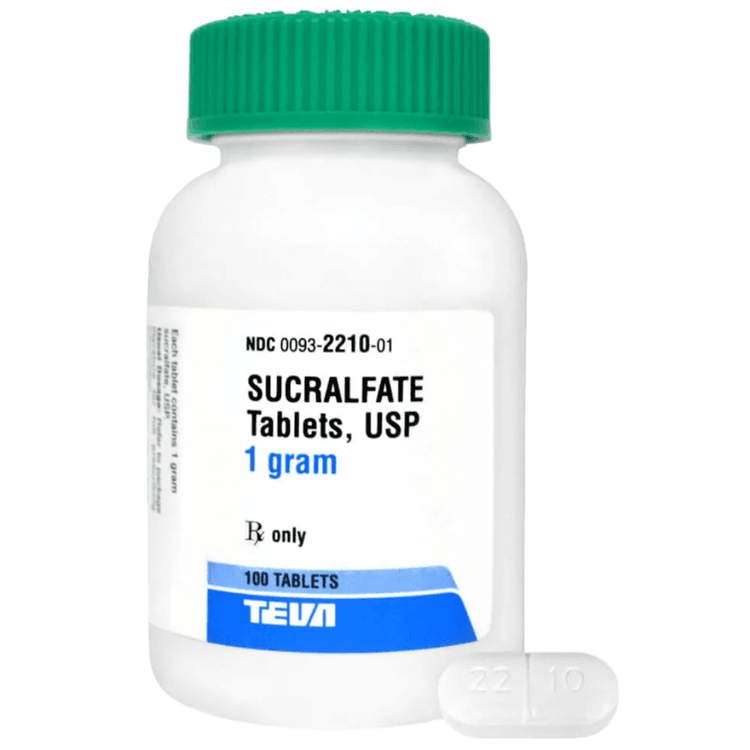
Sucralfate
Buy Sucralfate Online
Secure Encrypted Payments
Buy Sucralfate online and compare current listed pricing, available tablet or liquid presentations, and key safety basics before placing an order. Match the selected product to your prescriber’s directions, including form, strength, and quantity. If your order requires prescription details, keep your prescriber information available so the pharmacy can complete any needed checks.
Sucralfate is commonly used for active duodenal ulcers, where it helps form a protective coating over the ulcer surface. Many customers compare sucralfate tablets with sucralfate oral suspension because the form can affect convenience, measuring, and the way the medicine fits into a daily routine.
Sucralfate Price and Available Options
Use the product listing to compare the current sucralfate price against the exact presentation on your order. The most important details are form, strength, concentration, and total quantity. A sucralfate 1 g tablet listing is not the same as a liquid bottle, even when both contain the same active ingredient.
Common presentations include sucralfate tablets and sucralfate suspension. Tablets are often listed as 1 g units, while liquid products are commonly expressed as 1 g per 10 mL. That concentration matters because the total bottle volume and measured amount determine how many labeled doses the bottle may contain.
Quick tip: Compare the selected form and quantity before comparing totals.
People paying without insurance may focus on the sucralfate cost shown for each option. Check whether the listing is for tablets, oral suspension, or a related branded product. If your prescriber wrote for a specific presentation, switching to a different form should be discussed before ordering.
| Product detail | What to check |
|---|---|
| Form | Tablet, oral suspension, or another listed presentation |
| Strength | Examples may include sucralfate 1 g or 1 g per 10 mL |
| Quantity | Total tablets, bottle size, or supplied volume |
| Brand status | Generic carafate or a brand-name option when listed |
How to Order Sucralfate Online
Choose the listing that matches the written directions you received. Confirm whether the order is for a sucralfate 1gm tablet, sucralfate liquid, or another presentation. If the product requires prescription information, those details may be checked with the prescriber before dispensing.
For customers comparing cross-border access, US delivery from Canada may be available when the selected order can be filled. BorderFreeHealth supports cash-pay prescription access options for U.S. patients, subject to medication-specific and location-specific requirements.
Before checkout, review the form, strength, and quantity one more time. Keep the original container instructions in mind, especially when ordering sucralfate oral suspension. Liquid products need accurate measuring, while tablets may be simpler for travel or storage.
Forms, Strengths, and Product Selection
Sucralfate medication is available in solid and liquid forms. Many prescriptions refer to sucralfate 1gm, sucralfate 1 g tablet, sucralfate 1 gram tablet, or sucralfate tablets USP 1 gram. These terms usually point to the same labeled tablet strength, but the wording on your prescription should guide the order.
Oral liquid products may be described as sucralfate suspension, sucralfate oral suspension, or carafate suspension. A suspension contains particles dispersed in liquid, so the bottle may need shaking before measuring. Use a marked oral syringe, cup, or dosing device rather than a household spoon.
Some patients compare generic carafate with brand references such as Carafate tablets. Generic products contain the active ingredient sucralfate, but inactive ingredients, bottle sizes, and manufacturers can differ. If consistency matters for swallowing, flavor, or measuring, ask your clinician or pharmacist what should stay the same.
If you are exploring a liquid option, the related Sulcrate Suspension Plus listing may help you compare a suspension-style product when it matches your prescription.
What It Is Used For
Sucralfate for ulcers is used most often for short-term treatment of active duodenal ulcers, which are sores in the first part of the small intestine. It works mainly at the site of injury. In an acidic environment, it can bind to proteins at the ulcer surface and create a protective barrier.
This action is different from acid-suppressing medicines. Sucralfate does not work like a proton pump inhibitor or H2 blocker. Instead, it coats the ulcer area and may reduce contact with acid, pepsin, and bile salts while healing occurs.
Customers with a duodenal ulcer diagnosis can browse related product options through the Duodenal Ulcer collection. If your diagnosis involves stomach ulcers or esophageal inflammation, the Gastric Ulcer and Esophagitis collections may help you understand adjacent browsing categories.
Taking It Correctly
Follow the sucralfate dosage directions provided by your clinician and the product label. Typical labeled regimens often involve taking it on an empty stomach, but your exact schedule may depend on the reason it was prescribed and any other medicines you use.
Timing is important because this medicine can bind to other oral drugs and reduce how much of them is absorbed. Your clinician may separate sucralfate from thyroid medicine, certain antibiotics, digoxin, warfarin, or other products. Do not change timing on your own if your medication schedule is complex.
If you miss a dose, follow the patient instructions provided with your medicine. Many labels advise taking a missed dose when remembered unless it is close to the next scheduled dose. Extra doses should not be used to make up for a missed one unless your prescriber specifically tells you to do so.
Why it matters: The right spacing helps reduce avoidable interaction problems.
Storage, Handling, and Travel
Store tablets and suspension as directed on the label, usually at room temperature and away from excess moisture. Keep the cap tightly closed. Store the medicine out of reach of children and pets, and keep it in the original labeled container.
When traveling, carry enough medicine for the trip and keep the label visible. A copy of the prescription or clinic note can help if questions come up during travel. Do not leave the product in a hot car, near a window, or anywhere it may freeze.
Liquid products deserve extra attention. Keep the measuring device with the bottle, and check whether the suspension should be shaken before each measured amount. If the appearance changes, the cap is damaged, or the bottle leaks, ask a pharmacist before using it.
Orders that can be filled may Ships from Canada to US with prompt, express shipping, when available for the selected product. Shipping language does not change storage needs after the package arrives, so check the label before putting it away.
Side Effects and Safety Checks
The most common side effect of sucralfate is constipation. Other possible effects include gas, dry mouth, nausea, stomach discomfort, indigestion, or a feeling of fullness. These effects are often mild, but persistent or troubling symptoms should be discussed with a healthcare professional.
Serious reactions are uncommon but need prompt attention. Seek medical help for trouble breathing, swelling of the face or throat, severe abdominal pain, black or bloody stools, or symptoms that feel unusual or urgent. People with swallowing problems or reduced stomach movement should be especially careful with product form selection.
Sucralfate contains aluminum. People with significant kidney impairment may have a higher risk of aluminum accumulation, especially with longer use. Tell your clinician about kidney disease, dialysis, pregnancy, breastfeeding, feeding tubes, swallowing difficulty, and any history of gastrointestinal motility problems.
This medicine is for oral use only. It should not be injected. Very serious harm can occur if an oral suspension or tablet preparation is given by the wrong route.
Interactions and What to Avoid
Sucralfate can interfere with the absorption of several medicines. Products that may need spacing include fluoroquinolone antibiotics, tetracycline antibiotics, levothyroxine, digoxin, phenytoin, and warfarin. This is not a complete interaction list, so provide a current medication list before starting therapy.
Antacids may also affect timing. Some labels advise avoiding antacids close to sucralfate doses unless a clinician gives specific instructions. Alcohol, smoking, and frequent use of ulcer-irritating pain relievers can also work against ulcer healing for some people.
Food timing can matter. If you eat soon after a dose, the coating effect may not match the intended schedule. Ask your clinician how much time to leave between doses and meals, especially if your routine makes empty-stomach dosing difficult.
Compare Related Gastrointestinal Options
Sucralfate is a coating agent, not an acid reducer. Some treatment plans include acid-suppressing therapy, while others use a protective agent alone. The right approach depends on diagnosis, symptom pattern, other medicines, and clinician preference.
To browse related ulcer and acid-care products, use the Gastrointestinal product category. This can help you compare medication classes without mixing up the specific role of sucralfate carafate products.
If your symptoms involve reflux, esophageal irritation, stomach ulcers, or recurrent ulcer pain, confirm the diagnosis before comparing alternatives. Similar symptoms can come from different conditions, and product selection should match the condition being treated.
Authoritative Sources
Official labeling information is available in the FDA-approved Carafate prescribing information.
Patient-friendly medication details are provided by MedlinePlus sucralfate drug information.
This content is for informational purposes only and is not a substitute for professional medical advice.
Express Shipping - from $25.00
Shipping with this method takes 3-5 days
Prices:
- Dry-Packed Products $25.00
- Cold-Packed Products $35.00
Shipping Countries:
- United States (all contiguous states**)
- Worldwide (excludes some countries***)
Standard Shipping - $15.00
Shipping with this method takes 5-10 days
Prices:
- Dry-Packed Products $15.00
- Not available for Cold-Packed products
Shipping Countries:
- United States (all contiguous states**)
- Worldwide (excludes some countries***)
What is the purpose of taking sucralfate?
Sucralfate is used to help treat active duodenal ulcers. It works locally in the digestive tract by forming a protective coating over the ulcer surface. That barrier may help shield the area from stomach acid and digestive enzymes while healing occurs. It is not a pain reliever and does not reduce acid production like a proton pump inhibitor or H2 blocker. Your clinician may prescribe it alone or with other ulcer treatments depending on your diagnosis.
What is the most common side effect of sucralfate?
Constipation is commonly reported with sucralfate. Some people may also notice gas, nausea, dry mouth, indigestion, or stomach discomfort. Contact a healthcare professional if side effects are severe, persistent, or accompanied by symptoms such as trouble breathing, swelling, black or bloody stools, or severe abdominal pain. People with kidney disease should discuss safety carefully because sucralfate contains aluminum.
What should you avoid when taking sucralfate?
Avoid taking other oral medicines too close to sucralfate unless your clinician has confirmed the timing. It can bind to certain medications and reduce absorption. Antacids may also need to be separated from doses. Alcohol, smoking, and frequent use of ulcer-irritating pain relievers can make ulcer symptoms harder to manage for some people. Ask your clinician for a timing plan that fits your full medication list.
What happens if I eat 30 minutes after taking sucralfate?
Food timing may affect how well sucralfate coats the ulcer surface. Many instructions call for taking it on an empty stomach, often before meals, but your exact schedule should come from your clinician or product label. If your routine makes empty-stomach dosing difficult, ask how much separation from meals is needed. Do not double doses or change the schedule without professional guidance.
What should I ask my clinician before using sucralfate?
Ask whether tablets or suspension are better for your situation, especially if swallowing is difficult. Review how to space sucralfate from antibiotics, thyroid medicine, heart medicines, blood thinners, or antacids. It is also helpful to ask what symptoms should prompt a call, whether acid-reducing therapy is needed, and how long treatment is expected to continue. Mention kidney disease, pregnancy, breastfeeding, feeding tubes, or prior stomach surgery.
Rewards Program
Earn points on birthdays, product orders, reviews, friend referrals, and more! Enjoy your medication at unparalleled discounts while reaping rewards for every step you take with us.
You can read more about rewards here.
POINT VALUE
How to earn points
- 1Create an account and start earning.
- 2Earn points every time you shop or perform certain actions.
- 3Redeem points for exclusive discounts.
You Might Also Like
Select options
This product has multiple variants. The options may be chosen on the product page
Select options
This product has multiple variants. The options may be chosen on the product page
Select options
This product has multiple variants. The options may be chosen on the product page
Select options
This product has multiple variants. The options may be chosen on the product page