
Please note: a valid prescription is required for all prescription medication.
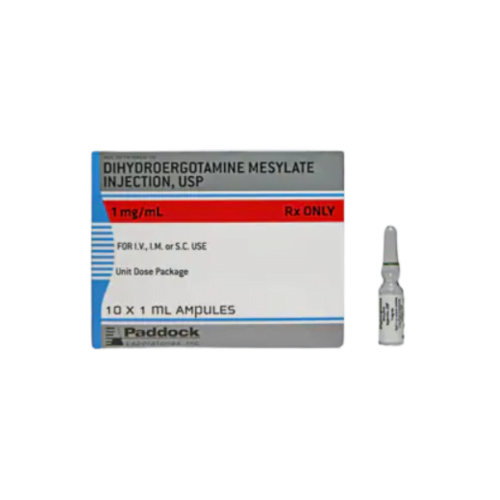
Dihydroergotamine (DHE) Injection
Buy Dihydroergotamine (DHE) Injection Online
Secure Encrypted Payments
Dihydroergotamine (DHE) Injection is an injectable ergot medicine used for acute migraine attacks and certain cluster headaches. It can be ordered online with the strength shown during checkout, including the 1 mg/mL injection when available, and it should be matched to the directions from your clinician. This medicine is for attacks already in progress, not for daily migraine prevention.
DHE may be useful when severe headache attacks need a non-oral rescue approach, especially if nausea or vomiting makes tablets difficult. Because it narrows blood vessels, the decision to use it should account for heart, circulation, blood pressure, pregnancy, and interaction risks. If a headache is sudden, unusually severe, or different from your established pattern, urgent medical assessment is more important than choosing a rescue treatment.
Dihydroergotamine Injection Price, Strength, and Ordering Basics
You can buy Dihydroergotamine Injection online and view the current price before completing your order. Choose the dose or strength shown for the product, then make sure it matches the clinician directions you were given. For this medicine, the stated form is injectable dihydroergotamine mesylate, and the listed strength is 1 mg/mL.
The final cost can vary by quantity, source pharmacy, and whether your care plan requires a different rescue option. People paying cash may want to gather their medication list, allergy history, and notes about prior migraine treatments before starting, because those details can affect safe use. For broader condition browsing, the Migraine section groups related migraine information and treatment categories.
US delivery from Canada may be available through licensed pharmacies, and order details may be reviewed before the medicine is supplied. Keep the product name, strength, and route consistent with your clinician’s plan, especially if you have previously used nasal DHE, triptans, or infusion-based treatment.
What DHE Injection Is Used For
Dihydroergotamine mesylate injection is used for the acute treatment of migraine headaches with or without aura and for the acute treatment of cluster headache episodes. It is not an ordinary pain reliever and is not intended for routine daily use to prevent future attacks. The goal is to treat an active attack when the diagnosis and treatment plan are clear.
DHE belongs to the ergot medicine class. It can act on serotonin and other receptors involved in headache pathways, and it can constrict blood vessels. That blood-vessel effect is one reason it may help some attacks, but it is also why careful screening for cardiovascular and circulation risks matters.
Some people encounter DHE in a clinic or hospital as an intravenous infusion for hard-to-break migraine attacks. That setting is different from at-home injection use. A supervised infusion may involve monitoring, anti-nausea medicine, and repeated administration under a protocol, while home use requires clear training and instructions for when to treat, when not to repeat, and when to seek help.
For patients dealing with severe one-sided attacks, the Cluster Headache section may help place DHE among other condition-specific topics. A sudden first-time cluster-like headache, new neurologic symptoms, or a major change in attack pattern should be assessed promptly.
Who May Be a Good Fit
DHE Injection is generally considered for adults with established migraine or cluster headache when a clinician believes an ergot-based rescue medicine fits the attack pattern. It may be considered when nausea, vomiting, or rapid escalation makes oral medicine less practical. It may also be part of a plan for people whose prior acute treatments have not provided enough relief or have not been easy to use during an attack.
This medicine may not fit people with coronary artery disease, peripheral vascular disease, uncontrolled high blood pressure, certain serious infections, significant liver or kidney disease, or a history suggesting unsafe vasoconstriction. Pregnancy is also a major concern because ergot medicines can affect uterine activity and blood flow. Breastfeeding, planned surgery, and recent use of other headache rescue medicines should be discussed with a healthcare professional.
The diagnosis matters. DHE should not be used as a guess for unexplained neurologic events, a first or worst headache, head injury symptoms, or headache with fainting, weakness, trouble speaking, confusion, fever, stiff neck, or vision loss that is not typical for you. Those situations need medical attention rather than a routine rescue dose.
Why it matters: DHE can be effective for selected attacks, but its blood-vessel effects make suitability screening essential.
How Administration and Timing Are Usually Handled
Dihydroergotamine Injection should be used only by the route and schedule in your care instructions and the official labeling. Route matters: subcutaneous, intramuscular, and intravenous administration are not interchangeable for a person simply because the active ingredient is the same. If home injection is part of your plan, training should cover preparation, injection site selection, equipment use, and sharps disposal.
- Attack treatment: DHE is used for a headache attack already in progress.
- Route-specific directions: follow the exact injection route provided with your medicine.
- Repeat limits: do not repeat treatment beyond the instructed schedule.
- Technique: use the supplied needles, syringes, and handling steps as directed.
- Emergency signs: do not delay care for chest pain, neurologic changes, or a new severe headache.
Many people ask how quickly DHE works. Response can depend on the route, how long the attack has been underway, whether vomiting is present, and whether other rescue medicines were recently used. An intravenous DHE infusion in a monitored setting may feel different from a single home injection, because infusion care often includes observation and supportive medicines.
People also ask how DHE may make them feel. Nausea, flushing, dizziness, tiredness, tingling, warmth, or injection-site discomfort can occur. Some patients feel relief as the migraine begins to settle, while others may need a broader plan if attacks keep returning or rescue treatment becomes frequent.
Strengths, Form, and DHE Infusion Distinctions
This medication is injectable dihydroergotamine mesylate rather than an oral tablet. The product strength referenced here is 1 mg/mL. Packaging, source labeling, and quantity may vary through pharmacy supply, so the medicine you receive should be checked against the strength and route in your treatment directions.
| Feature | What to know |
|---|---|
| Active ingredient | Dihydroergotamine mesylate |
| Medicine class | Ergot-derived acute headache treatment |
| Form | Injectable medicine |
| Listed strength | 1 mg/mL |
| Use context | Active migraine attacks with or without aura, and certain cluster headache episodes |
DHE is sometimes discussed under brand names or infusion protocols, including D.H.E. 45 injection. Brand naming and marketed presentations can differ by country and supply channel. The practical ordering decision is to match the active ingredient, strength, route, and quantity to the directions provided for you.
A DHE infusion is not the same as deciding to use an injectable product at home. Infusions are typically administered in a monitored care setting, especially for severe or prolonged attacks. Home injection requires confidence with preparation, administration, storage, and knowing when the medicine should be avoided.
Storage, Handling, and Travel
Store Dihydroergotamine Injection according to the carton, container, and pharmacy label. Keep it protected from excess heat and moisture, and do not use it after the expiry date. Leave the medicine in its original packaging when possible so the strength, route, and storage directions remain easy to verify.
If your instructions allow home use, inspect the solution before administration. Do not use it if it appears cloudy, discolored, or contains particles unless a pharmacist or clinician confirms it is acceptable. Store needles, syringes, alcohol swabs, and sharps containers away from children and pets.
Travel requires extra care because injectable medicines can be damaged or confused with other supplies. Keep the labeled container with the medicine, carry enough injection supplies for the trip, and use a puncture-resistant sharps container for disposal. Prompt, express shipping may be available depending on destination and pharmacy procedures.
Quick tip: Keep the labeled carton with your injection supplies so the strength and storage directions stay together.
Side Effects, Warnings, and Interactions
Dihydroergotamine Injection can cause side effects even when used correctly. Commonly reported effects include nausea, vomiting, dizziness, tiredness, flushing, sweating, tingling, muscle cramps, and soreness or irritation at the injection site. Nausea can be especially important because migraine itself may already cause stomach upset.
Serious symptoms need urgent care. Seek help for chest pain, shortness of breath, sudden severe weakness, trouble speaking, fainting, severe abdominal pain, blue or very cold fingers or toes, severe rash, or swelling of the face, lips, tongue, or throat. DHE can reduce blood flow in some circumstances, so chest symptoms or circulation changes should never be ignored.
Important interactions include other ergot medicines, triptans, and strong CYP3A4 inhibitors. CYP3A4 is a liver-enzyme pathway that helps process many medicines. Strong inhibitors can raise DHE exposure and increase the risk of serious blood-vessel problems; examples may include certain macrolide antibiotics, azole antifungals, and antiviral medicines. Always share a full list of medicines, supplements, nicotine use, and recent headache treatments with your healthcare team.
Medication overuse is also a concern with many rescue treatments. If attacks happen often enough that acute medicine is needed repeatedly, ask about a broader migraine strategy. Preventive therapy, trigger management, nausea control, and a clear rescue sequence may reduce the chance of unsafe repeat use.
The Neurology Articles section offers broader reading about neurologic conditions and treatment planning. Internal educational content can support questions for your clinician, but it should not replace individualized medical advice.
How DHE Compares With Other Rescue Options
DHE is one acute headache treatment among several. The right rescue option depends on how quickly attacks build, whether nausea prevents oral dosing, past response to triptans, cardiovascular risk, and how often headaches recur. Route can be just as important as the medicine name because severe migraine may make swallowing difficult.
Triptans, NSAIDs, gepants, anti-nausea medicines, nerve blocks, oxygen for cluster headache, and infusion protocols may all be discussed depending on the diagnosis. DHE and triptans both affect blood vessels, so they are not combined casually and usually require timing separation. NSAIDs may help some attacks but can be unsuitable for people with certain stomach, kidney, bleeding, or cardiovascular risks.
| Option type | Common route | When it may be discussed | Key caution |
|---|---|---|---|
| DHE injection | Injectable or supervised IV route | Active migraine or cluster headache when ergot therapy fits | Blood-vessel and interaction screening is important |
| Triptan rescue | Oral, nasal, or injectable forms | Often used for acute migraine attacks | Timing separation from DHE is usually required |
| NSAID rescue | Usually oral | May help pain and inflammation in selected attacks | Stomach, kidney, bleeding, and heart risks may limit use |
| Infusion care | IV in a monitored setting | May be used for prolonged or hard-to-break attacks | Requires professional monitoring and protocol-based care |
For category browsing beyond DHE, the Neurology Collection groups related neurologic medicines and care areas. Use related categories to understand the treatment landscape, then rely on clinician guidance for your own rescue plan.
Questions to Ask Before Using DHE
A short checklist can make DHE safer and easier to use. Ask which headache pattern should trigger use, which route is intended, how long to wait before any repeat administration, and which medicines must be separated from DHE. Clarify what to do if nausea prevents normal eating or drinking during an attack.
Ask whether your blood pressure, heart history, circulation symptoms, smoking or nicotine exposure, pregnancy plans, liver function, kidney function, or current medicines change your suitability. People with frequent attacks should also ask whether preventive therapy or a written rescue sequence would reduce repeated emergency visits or repeated acute medicine use.
If injection anxiety is a barrier, ask for hands-on training or supervised first use. Practical comfort matters: knowing how to draw up the medicine, choose the site, dispose of sharps, and recognize warning signs can determine whether home use is realistic. If those steps feel uncertain, a monitored setting may be safer.
Authoritative Sources
For official labeling, indications, contraindications, and route-specific safety information, see the D.H.E. 45 prescribing information.
For patient-focused drug facts, cautions, and interaction reminders, review MedlinePlus dihydroergotamine injection information.
For migraine-focused background on DHE forms and clinical use context, see the American Migraine Foundation DHE overview.
This content is for informational purposes only and is not a substitute for professional medical advice.
Research & Education Tool
Dihydroergotamine (DHE) Injection Dosage Calculator
Enter the vial amount, diluent volume, and target amount to estimate concentration, draw volume on a 1 mL U-100 syringe, and approximate vial yield.
For research and educational use only. Check all values against the product label, certificate of analysis, and any applicable professional guidance before relying on the result.
mg
Concentration
-
mcg / mL
Volume per Dose
-
-
Estimated Draws / Vial
-
rounded down to whole draws
Draw Reference
Enter values to estimate the syringe mark.
0
-
-
-
-
Express Shipping - from $29.99
Shipping with this method takes 3-5 days
Prices:
- Dry-Packed Products $29.99
- Cold-Packed Products $39.99
Shipping Countries:
- United States (all contiguous states**)
- Worldwide (excludes some countries***)
Standard Shipping - $19.99
Shipping with this method takes 5-10 days
Prices:
- Dry-Packed Products $19.99
- Not available for Cold-Packed products
Shipping Countries:
- United States (all contiguous states**)
- Worldwide (excludes some countries***)
What is Dihydroergotamine Injection used for?
Dihydroergotamine Injection is used for acute migraine attacks with or without aura and for certain cluster headache episodes. It is a rescue treatment for attacks already in progress, not a daily prevention medicine.
How does DHE Injection make you feel?
Some people may feel nausea, dizziness, tiredness, flushing, tingling, warmth, or injection-site soreness. Chest pain, severe weakness, trouble speaking, very cold or blue fingers or toes, or breathing problems need urgent medical attention.
Is a DHE infusion the same as DHE Injection at home?
No. A DHE infusion is given intravenously in a monitored care setting, often for severe or prolonged attacks. Home injection requires route-specific directions, injection training, and clear limits on repeat use.
Can Dihydroergotamine Injection be taken with triptans?
DHE and triptans both affect blood vessels and are generally separated by a specific time window. Follow your clinician’s instructions and share all recent migraine medicines before using DHE.
What should be checked before using DHE Injection?
Important checks include heart and blood-vessel history, blood pressure, pregnancy status, liver or kidney disease, nicotine use, allergies, and interacting medicines such as strong CYP3A4 inhibitors, triptans, and other ergot medicines.
Rewards Program
Earn points on birthdays, product orders, reviews, friend referrals, and more! Enjoy your medication at unparalleled discounts while reaping rewards for every step you take with us.
You can read more about rewards here.
POINT VALUE
How to earn points
- 1Create an account and start earning.
- 2Earn points every time you shop or perform certain actions.
- 3Redeem points for exclusive discounts.
You Might Also Like
Select options
This product has multiple variants. The options may be chosen on the product page
Select options
This product has multiple variants. The options may be chosen on the product page
Select options
This product has multiple variants. The options may be chosen on the product page
Select options
This product has multiple variants. The options may be chosen on the product page