
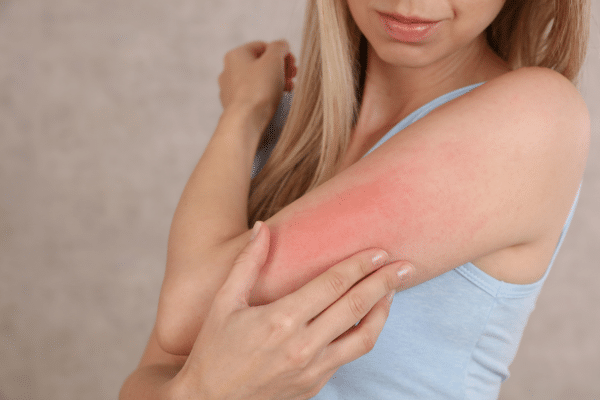
Clobetasol is a very strong topical corticosteroid (steroid that calms inflammation), so clobetasol propionate side effects can range from brief burning or dryness to more serious problems like skin thinning when it is used too often, too long, or on delicate areas. Most reactions stay local to the treated skin, but the drug’s strength is exactly why careful use matters.
That matters because the same medicine that can settle stubborn eczema, psoriasis, or scalp inflammation may also irritate thin skin, hide infection, or create extra risk around the eyes and face. Knowing what is expected, what is not, and where not to apply it helps you use the medication more safely and know when to check in with a clinician.
Key Takeaways
- Clobetasol is a very high-potency topical steroid.
- Mild burning, stinging, dryness, and redness can happen early.
- Risk rises on the face, groin, armpits, eyelids, and broken skin.
- Longer or heavier use may lead to skin thinning and color changes.
- New infection, allergy signs, eye symptoms, or worsening rash deserve prompt medical review.
Clobetasol Propionate Side Effects to Watch For
Most side effects happen where the medicine is applied. Early reactions often include burning, stinging, itching, dryness, redness, peeling, or a tight feeling in the skin. These can be brief when treatment starts, especially on already inflamed skin. In other cases, they signal that the product is too irritating for that body area or that the diagnosis needs a second look.
Some people also notice acne-like bumps, inflamed hair follicles, or changes in skin color. On the scalp, tenderness, dryness, or soreness can happen, especially if the skin is cracked from scratching. People searching for clobetasol cream side effects, clobetasol ointment side effects, or clobetasol shampoo side effects are usually seeing this same local pattern first. The active drug is similar across forms, even though the base or vehicle can change how it feels.
| Form | Common local reactions | What to keep in mind |
|---|---|---|
| Cream or ointment | Burning, dryness, redness, peeling | Ointments can feel heavier and may trap moisture on irritated skin. |
| Lotion or scalp solution | Stinging, dryness, tenderness | Liquid forms may feel sharper on cracked or scratched areas. |
| Shampoo | Scalp irritation, soreness, dryness | Keep it away from the eyes and follow the body-area instructions closely. |
If you are comparing products such as Clonate Ointment 0.05 and Clonate Scalp Lotion, remember that the formulation changes the feel, not the need for caution. A scalp product is not automatically safer on other areas, and an ointment is not automatically the right choice for thin skin. The safest fit depends on the diagnosis, the body site, and how long the treatment was meant to last.
Why This Topical Steroid Can Cause Side Effects
Clobetasol is considered a very potent topical steroid. It works by quieting inflammatory signals in the skin, which can reduce redness, swelling, itching, and scaling. That same anti-inflammatory effect can also lower the skin’s normal repair and defense response. When use becomes too aggressive, the medicine may calm the rash while also making the skin more fragile.
Several factors change the risk. Thin skin absorbs more medicine than thicker skin. Skin folds hold moisture and friction, which can increase absorption. Large treatment areas raise exposure. Tight dressings and some diapers can act like occlusion, meaning they trap the medicine against the skin and push more of it inward. Broken or infected skin can also behave differently. Children may be more vulnerable because of their body size and skin surface area.
The form matters too, but only up to a point. Creams, ointments, lotions, foams, and shampoos may feel different and suit different body areas, yet they still carry the same broad steroid warnings. If you are sorting through skin-care options in Dermatology or browsing the Dermatology Treatments hub, it helps to separate moisturizers, antifungals, and strong steroids rather than treating them as interchangeable. The same caution applies when reading the product details for Clobetasol.
Why it matters: Potent steroids can calm severe inflammation quickly, but delicate skin can absorb more medicine.
BorderFreeHealth works with licensed Canadian partner pharmacies for eligible U.S. patients.
When Side Effects Are More Concerning
More serious clobetasol side effects are less common, but they are the problems people most want to avoid. These issues are more likely after repeated courses, long-term daily use, treatment over large areas, or application to the face, eyelids, genitals, or skin folds. Mild burning may show up quickly. Structural skin changes usually develop more gradually.
Skin thinning and visible changes
One of the main long-term concerns is atrophy (skin thinning). The skin may start to look shiny, paper-like, or easier to bruise. Some people develop striae (stretch marks) or telangiectasia (tiny visible blood vessels). Color changes can also happen. The skin may become lighter, darker, or patchy after inflammation settles. These changes can be slow to reverse, and some may persist even after the medicine is stopped.
This risk matters most on thin or sensitive areas. The face, around the eyes, under the breasts, the groin, and the armpits are less forgiving than elbows, knees, palms, or thick scalp plaques. Using a strong steroid on the wrong site can make a short-term irritation problem turn into a longer-term skin quality problem.
Infections, allergy, and eye-area risks
Topical steroids can make infection harder to spot because they reduce redness and itching. That may delay care while a bacterial, fungal, or viral process continues underneath. Warning signs include increasing warmth, swelling, pus, pain, crusting, or a rash that spreads instead of settles. A true allergy to the product is less common, but it can happen. If the treated area becomes much redder, itchier, swollen, or blistered, the medicine itself may be part of the problem.
Clobetasol should also be kept away from the eyes unless a specialist specifically directed otherwise. Potent steroids used on the eyelids or too close to the eyes may raise the risk of eye complications, including glaucoma or cataracts. Eye pain, blurred vision, halos, or new irritation after facial use are not symptoms to ignore.
Whole-body exposure is uncommon, but possible
Systemic absorption (medicine entering the bloodstream) is not the usual outcome, but it can happen when a high-potency steroid is used over large areas, under occlusion, for long periods, or in children. A clinician may become concerned about broader steroid exposure if use has been heavy or prolonged. This is one reason strong topical steroids are usually prescribed with limits on body site and duration, not as open-ended daily maintenance.
Where Not to Use It and How to Lower Risk
In general, clobetasol should not be used on delicate or damaged skin unless a clinician specifically told you to do so. That includes the face, eyelids, around the eyes, the groin, genitals, armpits, and other skin folds. It is also usually avoided on untreated infected skin, open wounds, or inside the mouth, nose, or other mucous membranes. Daily use is not usually meant to continue indefinitely. When daily application is prescribed, it is typically for a short, defined plan rather than ongoing routine use.
- Thin layer only: apply just where it was prescribed.
- Body site matters: do not move it to new areas on your own.
- Watch the calendar: old leftover tubes can create new problems.
- Avoid tight covering: do not seal it under dressings unless directed.
- Keep it simple: limit extra topicals on the same spot when a reaction appears.
- Check for warning signs: bruising, thinning, eye symptoms, or worsening rash need review.
The best way to lower clobetasol propionate side effects is to use the smallest amount on the smallest area for the shortest period your treatment plan intended. If you are unsure whether a patch of skin still needs the medicine, or whether it is safe to keep applying it every day, that uncertainty is a good reason to pause and confirm the plan instead of guessing. Potent steroids work best when the instructions are specific.
If a rash improves at first and then flares again, resist the urge to keep restarting strong steroid treatment without reassessing the cause. A condition that looks inflamed may actually be infected, irritated by another product, or be a facial disorder that reacts badly to potent steroids.
If a prescription is required, the dispensing pharmacy may confirm it with the original prescriber.
When Diagnosis Changes the Safety Picture
Diagnosis matters because a medicine that helps one inflamed rash can aggravate another. Thick psoriasis plaques on elbows or the scalp are not the same as eczema in skin folds, and neither looks like every facial rash. If you are reading about blistering or itchy hand and foot rashes, these resources on Dyshidrotic Eczema and Stress And Dyshidrotic Eczema show why pattern, triggers, and body site matter before you assume a strong steroid is the answer.
The same idea applies to psoriasis and scalp disease. Broader context from World Psoriasis Day 2025 can help frame why chronic inflammatory skin disease often needs a plan beyond one tube of medicine. Some scalp conditions may call for non-steroid treatment approaches, with products such as Ketoderm, while some facial redness conditions are approached very differently, with products such as Noritate Cream. That context helps explain why clobetasol propionate side effects are not just about the drug itself; they are also about whether the diagnosis and body site fit the treatment.
What to Do If a Reaction Starts
If you think the medicine is irritating your skin, the safest next step is to pause and assess the pattern rather than adding more products on top of it. Note when the reaction started, what form you used, how often you were applying it, and exactly where it went on the body. New redness after the first few uses is different from gradual thinning after weeks of frequent use, and both are different from swelling or blistering that suggests allergy.
Quick tip: Take a clear photo of the area before washing it off so you can track changes.
Get prompt medical advice if you develop severe burning, rapid swelling, hives, blistering, pus, fever, eye pain, vision changes, or a rash that spreads beyond the treated site. Seek urgent care for trouble breathing or swelling of the lips, tongue, or throat. Even when the reaction seems mild, it helps to bring the product name, the container, and a list of any other creams or shampoos used on the same area. That makes it easier to sort out irritation, overuse, allergy, or infection.
Cash-pay cross-border prescription options depend on eligibility and local jurisdiction.
Authoritative Sources
- MedlinePlus drug information for clobetasol topical
- NHS overview of side effects of clobetasol
- DailyMed label information for clobetasol lotion
Clobetasol can be very useful for short-term control of severe skin inflammation, but its strength is what makes body site, duration, and follow-up so important. The goal is not to fear the medicine. It is to use it with enough respect that common irritation stays manageable and more serious complications stay uncommon.
This content is for informational purposes only and is not a substitute for professional medical advice.


