

Please note: a valid prescription is required for all prescription medication.
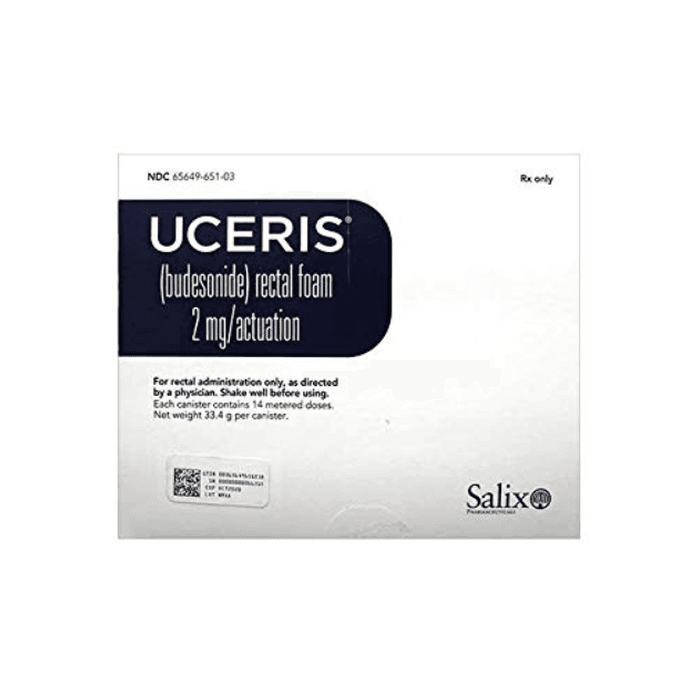
Uceris Rectal Foam
Buy Uceris Rectal Foam Online
Secure Encrypted Payments
Buy Uceris Rectal Foam online and compare current listed pricing, available presentations, access details, and key safety basics before you place an order. You can review the Uceris Rectal Foam price, match the selected product to your prescribed form, and check practical handling points on this page. For customers comparing Uceris Rectal Foam Canada options, BorderFreeHealth supports cash-pay, cross-border access when order details meet applicable requirements.
Uceris foam contains budesonide, a corticosteroid used rectally for adults with mild to moderate distal ulcerative colitis. Because it is a rectal foam, the product details that matter most are the strength per actuation, canister presentation, supplied applicators, quantity, and whether the listing matches the directions from your clinician.
Uceris Rectal Foam Price and Available Options
Start by comparing the currently listed product details beside the selected quantity. Uceris Rectal Foam cost can reflect the presentation shown on the page, the number of canisters or applicators supplied, and whether the product is listed as the brand or a budesonide rectal foam equivalent where available. Check the name, strength, and form before continuing, since a rectal foam is not interchangeable with an enema, tablet, or suppository without a clinician’s direction.
A common presentation is Uceris Rectal Foam 2 mg per metered actuation. That strength describes the amount delivered with each actuation, not the entire canister contents. The package may include a pressurized canister and disposable applicators, so the selected quantity should be compared against the course length written in your treatment plan rather than guessed from the canister alone.
If you are paying cash or comparing Uceris Rectal Foam without insurance, focus on the total order cost for the exact presentation selected. Different rectal therapies may have different package sizes, coverage rules, or replacement options, so comparing only the product name may miss important differences. The Gastrointestinal category can help you browse related digestive health products when your clinician has discussed alternatives.
Quick tip: Match the selected strength, form, and quantity to your treatment instructions before checkout.
How to Order Uceris Rectal Foam Online
To order Uceris Rectal Foam online, choose the listed presentation that matches your clinical directions and provide the requested order details accurately. If prescription information is required for your order, those details may be checked with the prescriber before dispensing. Keeping your prescriber’s contact information available can help prevent avoidable delays.
BorderFreeHealth supports access to cash-pay cross-border prescription options for U.S. patients, subject to applicable order requirements. If your order is eligible for US delivery from Canada, review the selected product, quantity, and shipping information before submitting. Do not rely on product photos alone; packaging can differ by market while the active ingredient and form remain the key identifiers.
Customers comparing Uceris Rectal Foam cash pay options often want a simple way to evaluate current listed pricing and available supply. The practical steps are straightforward: confirm the product name, check whether the selected item is Uceris foam or another budesonide 2 mg rectal foam presentation, and keep your dosing schedule handy when choosing quantity. If anything on the listing does not match your clinician’s instructions, ask for clarification before completing the order.
What the Foam Is Used For
Budesonide rectal foam is a topical corticosteroid for adults with mild to moderate active ulcerative colitis that extends from the rectum into the nearby sigmoid colon. Distal ulcerative colitis means inflammation is limited to the lower part of the colon. Symptoms may include rectal bleeding, urgency, frequent bowel movements, or tenesmus, which is the feeling that the bowel is not fully emptied.
The foam is designed for rectal use only. It delivers budesonide directly to the inflamed mucosa, where it can reduce local inflammatory signaling. Compared with many systemic steroids, budesonide undergoes extensive first-pass metabolism, which may reduce but does not remove the chance of whole-body steroid effects.
This treatment is generally used as an induction therapy, meaning it helps control active symptoms over a defined course. It is not the same as a long-term maintenance plan unless your prescriber specifically includes it that way. The Ulcerative Colitis collection can help you view related product categories used for this condition.
Strength, Form, and Product Details
Uceris 2 mg rectal foam is supplied as a metered rectal foam in a pressurized canister. The package typically includes applicators made for rectal administration. Always use the applicators supplied with the product, because other devices may not deliver the dose properly or may cause discomfort.
When reviewing a listing, look for three details: the active ingredient, the delivered strength per actuation, and the route of use. Budesonide 2 mg rectal foam is not taken by mouth, and it should not be sprayed onto the skin. The route matters because the formulation is built to spread over rectal and lower-colon tissue after insertion.
Availability can change over time. If the selected foam is unavailable, your clinician may consider a different rectal steroid, a rectal 5-ASA product, or another formulation based on disease location and tolerance. Do not substitute a suppository, enema, or oral medicine on your own, even if the active drug class sounds similar.
How It Is Commonly Used
Follow the official label and your clinician’s instructions for your exact regimen. A common labeled schedule uses rectal administration twice daily for the first part of treatment, followed by once-daily bedtime use for the remaining course. Your directions may differ, especially if other rectal or oral medicines are part of the plan.
General technique can affect comfort and retention. Emptying the bowel before use may make administration easier. Many people find lying on the side more comfortable. After the applicator is inserted, the foam should be delivered slowly as directed in the patient instructions. Wash your hands before and after handling the canister and applicator.
- Check the canister: confirm it is intact and not overheated.
- Use supplied applicators: do not reuse disposable applicators.
- Follow priming steps: use the package instructions when needed.
- Retain when possible: bedtime dosing may be easier to keep in place.
- Avoid double doses: follow missed-dose guidance from the label or clinician.
Why it matters: Correct technique helps the foam reach the intended lower bowel area.
Storage, Handling, and Travel
Store the canister at room temperature and keep it away from heat, sparks, open flame, or direct sunlight. The container is pressurized, so it should not be punctured, crushed, or incinerated. Keep it out of reach of children and pets, and do not leave it in a hot vehicle.
Used applicators should be discarded according to the package instructions and local household waste rules. No needles or sharps are involved. If your municipality has specific disposal guidance for medical applicators, follow those instructions.
For travel, pack the canister where it will be protected from impact and extreme temperatures. Carry enough applicators for the trip plus a spare if possible. Keeping the product in its labeled packaging can make it easier to identify during travel and can help you keep the correct instructions with the medicine. BorderFreeHealth may support Uceris Rectal Foam US shipping from Canada when the order pathway applies, but shipping arrangements should not replace proper storage after delivery.
Side Effects and Safety Basics
Uceris Rectal Foam for ulcerative colitis can cause side effects, even though the medicine is intended to act locally. Commonly reported effects may include headache, nausea, abdominal pain, gas, rectal discomfort, dizziness, fatigue, acne, or sleep changes. Some effects are mild, but new or worsening symptoms should be discussed with a healthcare professional.
Corticosteroids can also cause more serious problems. Possible systemic effects include adrenal suppression, Cushing-like features, mood changes, high blood pressure, elevated blood sugar, glaucoma, cataracts, bruising, and slower wound healing. Steroids may mask infection symptoms or make infections worse, including fungal, bacterial, or viral infections.
Seek urgent medical attention for severe abdominal pain, heavy or persistent rectal bleeding, signs of serious infection, fainting, sudden vision changes, or symptoms that suggest adrenal insufficiency such as severe weakness, low blood pressure, or vomiting. People with a history of tuberculosis, ocular herpes, glaucoma, cataracts, diabetes, osteoporosis, hypertension, or immune suppression should make sure those issues are part of the clinical review before using a steroid.
Interactions and Monitoring Points
Budesonide is metabolized mainly by CYP3A4, an enzyme involved in processing many medicines. Strong CYP3A4 inhibitors can increase budesonide exposure. Examples may include ketoconazole, itraconazole, clarithromycin, and some HIV protease inhibitors. Grapefruit and grapefruit juice can also affect CYP3A4 and are commonly avoided unless your clinician says otherwise.
Tell your care team about all prescription medicines, over-the-counter products, vitamins, and supplements you use. Extra caution may be needed with other immunosuppressive medicines or live vaccines. If you are switching from an oral steroid, your clinician may plan a taper to reduce steroid withdrawal and adrenal risks.
People with diabetes may need closer glucose monitoring because steroids can raise blood sugar. Those with eye disease, bone-health concerns, or high blood pressure may also need follow-up while using corticosteroid therapy. If pregnancy or breastfeeding is relevant, discuss risks and benefits with a qualified clinician before starting or continuing treatment.
Comparing Rectal Treatment Options
Rectal therapies differ by how far they reach, how easy they are to retain, and which drug class they contain. Foam can be easier for some people to hold than a liquid enema, especially when urgency is a major symptom. Enemas may cover a longer segment of the lower colon, while suppositories mainly target the rectum.
Mesalamine, also called 5-ASA, is another common class used for mild to moderate ulcerative colitis. If your clinician has discussed a rectal 5-ASA, compare prescribed options such as Pentasa Enema or Salofalk Suppositories only when they match your treatment plan. A steroid foam and a mesalamine product are not the same kind of medicine.
If you are comparing oral 5-ASA products with rectal treatment, the focused guide Asacol Vs Lialda can help frame questions about maintenance therapy and formulation differences. Your clinician is the right person to decide whether a local steroid, a rectal 5-ASA, an oral medicine, or a combination approach fits your disease location.
What to Ask Before Starting
Good questions can make an online order safer and more useful. Ask whether your inflammation location matches a rectal foam, how long the planned course should last, and what symptoms should trigger a call. If you use other rectal products, ask how to space them so one product does not displace another.
It is also reasonable to ask about the plan after induction. Many people with ulcerative colitis need a maintenance strategy once active symptoms improve. Clarify whether refills are expected, whether follow-up testing is planned, and how your clinician wants to monitor steroid-related risks.
- Disease location: confirm the lower-colon target area.
- Course length: ask how long to use it.
- Other medicines: review rectal and oral therapies.
- Safety triggers: know when to contact the clinic.
- Next step: discuss maintenance after symptoms improve.
Authoritative Sources
| Resource | What it supports |
|---|---|
| FDA prescribing information for Uceris rectal foam | Indication, administration, warnings, adverse reactions, and interactions. |
| Canadian product monograph for budesonide foam | Canadian labeling details, patient instructions, and safety information. |
Orders may be supported with prompt, express shipping when available for the selected product and access pathway.
This content is for informational purposes only and is not a substitute for professional medical advice.
Express Shipping - from $25.00
Shipping with this method takes 3-5 days
Prices:
- Dry-Packed Products $25.00
- Cold-Packed Products $35.00
Shipping Countries:
- United States (all contiguous states**)
- Worldwide (excludes some countries***)
Standard Shipping - $15.00
Shipping with this method takes 5-10 days
Prices:
- Dry-Packed Products $15.00
- Not available for Cold-Packed products
Shipping Countries:
- United States (all contiguous states**)
- Worldwide (excludes some countries***)
How do you use Uceris rectal foam?
Uceris rectal foam is used only in the rectum. The package instructions describe how to prepare the canister, attach the supplied applicator, position the body, insert the applicator, and release the foam. Many people are told to empty the bowel first because it can improve comfort and retention. Do not reuse disposable applicators, and do not take the foam by mouth. Follow the directions from your clinician and the official patient instructions for your exact schedule.
How long does budesonide rectal foam take to work?
Response time can vary. Some people notice symptom improvement during the treatment course, while others need reassessment if bleeding, urgency, or discomfort continues. Budesonide rectal foam is typically used for induction of remission, meaning it is intended to help control active inflammation over a limited course rather than serve as a long-term plan by itself. If symptoms worsen, or if severe pain or heavy bleeding occurs, contact a healthcare professional promptly.
Is Uceris foam a steroid?
Yes. Uceris foam contains budesonide, a corticosteroid. It is formulated for local rectal use in distal ulcerative colitis, which may limit systemic exposure compared with some oral steroids. That lower exposure does not remove steroid risks. Possible effects include adrenal suppression, high blood sugar, mood changes, eye problems, bruising, and infection concerns. Share your medical history and medication list with your clinician before using any corticosteroid treatment.
What side effects should be monitored with this medicine?
Common effects may include headache, nausea, gas, abdominal pain, rectal irritation, dizziness, fatigue, acne, or sleep changes. More serious concerns include infection, adrenal suppression, high blood pressure, high blood sugar, glaucoma, cataracts, and severe abdominal symptoms. Seek urgent care for severe pain, heavy bleeding, fainting, sudden vision changes, or signs of a serious infection. People with diabetes, eye disease, immune suppression, or prior steroid problems may need closer monitoring.
What should I ask my clinician before using budesonide rectal foam?
Ask whether your ulcerative colitis location is appropriate for a rectal foam, how long the planned course should last, and what to do if a dose is missed. It is also helpful to ask whether the foam can be used with rectal mesalamine or oral maintenance therapy, and how to space products if more than one rectal medicine is prescribed. Review infection history, diabetes, eye conditions, pregnancy, breastfeeding, and all current medicines before starting.
Rewards Program
Earn points on birthdays, product orders, reviews, friend referrals, and more! Enjoy your medication at unparalleled discounts while reaping rewards for every step you take with us.
You can read more about rewards here.
POINT VALUE
How to earn points
- 1Create an account and start earning.
- 2Earn points every time you shop or perform certain actions.
- 3Redeem points for exclusive discounts.
You Might Also Like
Select options
This product has multiple variants. The options may be chosen on the product page
Select options
This product has multiple variants. The options may be chosen on the product page
Select options
This product has multiple variants. The options may be chosen on the product page
Select options
This product has multiple variants. The options may be chosen on the product page