
Please note: a valid prescription is required for all prescription medication.
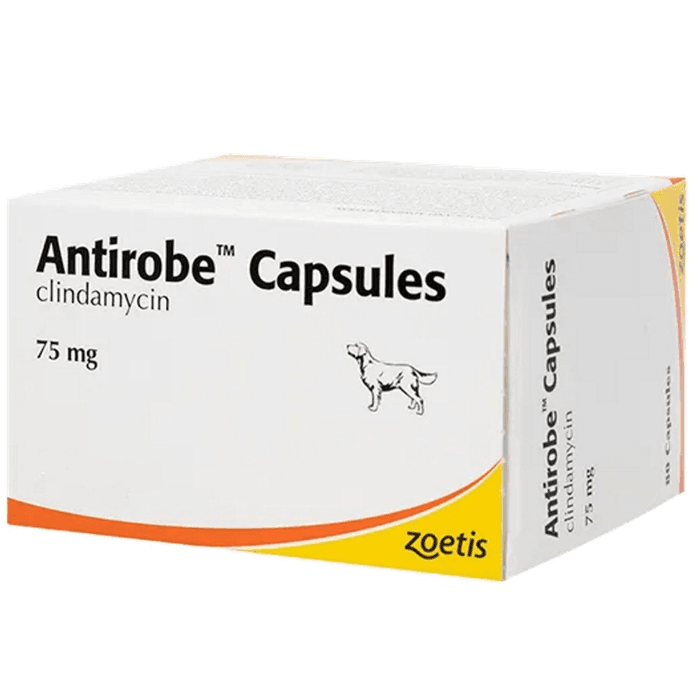
Antirobe
Buy Antirobe Online
Secure Encrypted Payments
Antirobe is a veterinary clindamycin antibiotic used for dogs and cats when susceptible bacterial infections are being treated. You can buy Antirobe online, view the current price, and choose the form or strength shown during ordering to match your veterinarian’s directions. Antirobe may be offered as capsules and, when available, as oral liquid known as Antirobe Aquadrops.
This medicine should be chosen by active ingredient, form, strength, quantity, and species instructions. Capsule strengths may include Antirobe 25 mg, Antirobe 75 mg, Antirobe 150 mg, and Antirobe 300mg, depending on what is currently offered. Liquid products should be matched by concentration and bottle directions rather than treated as equal to a capsule strength.
BorderFreeHealth offers cash-pay, cross-border ordering for many pet medicines, including US delivery from Canada when supported for the order. Keep the clinic label nearby while choosing Antirobe so the medicine, pet name, infection site, and treatment duration all align with veterinary instructions.
Antirobe Price and Strength Selection
The Antirobe price depends on the form, capsule strength, quantity, and current pharmacy supply. Antirobe 25 mg, Antirobe 75 mg, Antirobe 150 mg, and Antirobe 300mg contain different amounts of clindamycin per capsule, so the lowest unit price is not always the best match for your pet’s plan. Use the total course needs and the written directions to judge the practical value.
Antirobe capsules for dogs or cats may work well when the pet can swallow capsules reliably. Antirobe liquid or Antirobe Aquadrops may be preferred when the veterinarian wants flexible measuring or when capsules are difficult to give. If your pet’s instructions use a brand name, generic active ingredient, or abbreviation, match the wording to clindamycin hydrochloride and the exact strength before checkout.
Cash-pay customers often compare quantity, refill needs, and total contents together. A higher-strength capsule should not be substituted for a lower strength unless the veterinarian specifically directed that form and amount. Changing from capsules to liquid can also change the measuring routine, so treat the form as part of the medication order, not a simple convenience choice.
Quick tip: Match the strength on the bottle or capsule label with the strength written on your pet’s clinic instructions.
How to Order Antirobe Online
Choose Antirobe by species, form, strength, and quantity, then make sure those details match the veterinary treatment plan. Important order checks include whether the directions call for capsules or liquid, whether the pet is a dog or cat, and whether the course length matches the amount being purchased. If your veterinarian recently changed the dose, form, or duration, use the newest instructions.
We may review order details when needed so the pharmacy can supply the medicine with accurate pet and clinic information. Have the clinic name, pet weight, diagnosis details, and medicine directions available in case clarification is required. This helps prevent common ordering errors, especially when several capsule strengths appear similar.
For cross-border service, customers may consider Ships from Canada to US wording alongside the medicine quantity and checkout information. Treat shipping language as an order logistics detail rather than a medical factor. Prompt, express shipping may be available when shown during checkout.
Forms, Strengths, and Product Matching
Antirobe contains clindamycin hydrochloride, a lincosamide antibiotic used in veterinary medicine. Labels or clinic instructions may describe it as Antirobe clindamycin, clindamycin for dogs, or clindamycin for cats. These references point to the active ingredient, but safe ordering still depends on the exact medicine form and strength.
Capsule wording can vary in everyday use. Antirobe 25mg capsules, Antirobe capsules 75mg, Antirobe caps, and Antirobe clindamycin 150mg are practical ways people describe capsule strengths. They should not be used as dosing instructions. Smaller pets may be prescribed lower strengths, while larger dogs may need a different strength or combination chosen by the veterinarian.
Antirobe Aquadrops for cats or dogs refers to the oral liquid form when it is available. Liquid dosing depends on concentration, the measuring device, and the directions printed on the label. Shake, measure, and store the liquid exactly as instructed by the bottle or veterinary team.
| Attribute | What to match before ordering |
|---|---|
| Active ingredient | Clindamycin hydrochloride |
| Form | Capsule or oral liquid, as directed |
| Strength | The mg strength or liquid concentration on the clinic directions |
| Species | Dog or cat directions for the correct pet |
| Quantity | Enough medicine for the directed course, without changing the dose |
What This Veterinary Antibiotic Treats
Antirobe antibiotic therapy is used for infections caused by bacteria that are susceptible to clindamycin. Veterinary labeling and manufacturer information describe use in conditions such as infected wounds, abscesses, dental infections, and some bone infections when the veterinarian determines that clindamycin is appropriate. It is not used for viral illness, pain alone, or general inflammation without a bacterial target.
Antirobe for dogs may be chosen when the infection site and suspected bacteria fit clindamycin therapy. Antirobe for cats may be used when the veterinarian determines that the benefits and species-specific considerations support treatment. Culture and sensitivity testing, when performed, can help confirm whether the bacteria are likely to respond.
For broader browsing, the Pet Medications category includes related veterinary products. The Bacterial Infection collection can also help organize infection-related medicines, but it should not replace diagnosis or antibiotic selection by the veterinary team.
Using Antirobe as Directed
Give Antirobe exactly as your veterinarian instructed, including the timing and full treatment length. Many antibiotic plans use a defined course, and stopping early can allow infection signs to return. Do not add leftover antibiotics from another pet or change the schedule without veterinary guidance.
Capsules are generally intended to be swallowed whole. Some pets tolerate them better with a small amount of food, while others can take them without food if the clinic approves. If your pet vomits soon after a dose, refuses capsules repeatedly, or has trouble swallowing, contact the clinic before repeating the dose or switching forms.
For Antirobe liquid, use the measuring syringe or dosing device provided with the medicine. Household spoons can be inaccurate, especially for small animals. Close the cap tightly after use, keep the label readable, and make sure every caregiver follows the same timing instructions.
If a dose is missed, follow the clinic’s missed-dose plan when one was given. A common approach is to give the dose when remembered unless the next dose is close, then resume the regular schedule. Do not double the next dose unless a veterinarian specifically tells you to do so.
Safety, Side Effects, and Species Precautions
Review your pet’s medical history before giving clindamycin. Pets with known hypersensitivity to clindamycin or lincomycin should not receive Antirobe. Extra caution may be needed for dogs or cats with significant liver or kidney disease, because the veterinarian may want monitoring or a different medicine.
Digestive upset is among the more common concerns. Watch for vomiting, reduced appetite, soft stool, diarrhea, drooling, or resistance to the liquid taste. Contact the veterinary team promptly if diarrhea persists, blood appears in the stool, vomiting repeats, the pet becomes weak, or infection signs worsen.
- Common digestive signs: vomiting, loose stool, or reduced appetite.
- Liquid taste reaction: drooling, lip-smacking, or refusal.
- Allergy signs: facial swelling, hives, or breathing trouble.
- Worsening infection signs: fever, swelling, pain, or low energy.
Do not use clindamycin products in rabbits, hamsters, guinea pigs, horses, or similar sensitive species unless a specialist explicitly directs care. Severe gastrointestinal effects can occur in these animals. Store the medicine away from other pets so it is not accidentally eaten.
Why it matters: Antibiotic safety differs by species, and a medicine tolerated by a dog or cat may be dangerous for another animal.
Interactions and Monitoring During Treatment
Tell the veterinarian about all medicines, supplements, dental products, probiotics, stomach protectants, and recent injections your pet receives. Clindamycin may interact with neuromuscular-blocking agents used during anesthesia. It may also have antagonistic effects with some macrolide antibiotics, including erythromycin.
Mineral-containing products, gastrointestinal adsorbents, antidiarrheals, and some stomach treatments may need spacing from oral medicines. Ask the clinic how to time doses if your pet takes several products each day. Clear written timing is especially helpful when more than one person gives medication.
Track appetite, stool quality, energy, pain, swelling, and whether the infected area appears to improve. Some pets show improvement through better eating, less tenderness, or lower swelling, but response timing varies by infection site and severity. If signs worsen or do not improve as expected, the veterinarian may reassess the diagnosis, culture results, or antibiotic choice.
Storage, Handling, and Travel
Store Antirobe in the original container with the label attached. Keep the cap tightly closed, protect the medicine from heat and moisture, and place it out of reach of children and animals. Check the bottle or carton for any form-specific storage instructions, especially with the liquid.
Avoid moving capsules into unlabelled pill organizers unless a veterinarian or pharmacist confirms that doing so is appropriate. Original packaging preserves the medicine name, strength, lot information, and directions. It also reduces confusion when multiple pets in the home take different medicines.
When traveling, carry Antirobe with your pet’s records and keep it in hand luggage when practical. Pack the measuring device if using liquid, a small amount of food if approved for dosing, and the clinic contact information. Boarding facilities should receive clear written directions and the original labeled container.
How Antirobe Compares With Related Pet Antibiotics
Antirobe is not interchangeable with every pet antibiotic. The right choice depends on the bacteria, infection location, species, allergy history, and culture results when available. If your veterinarian discusses amoxicillin-clavulanate, What Is Clavamox explains common pet-use considerations for that antibiotic combination.
Different antibiotic classes may be used for different organisms or clinical situations. Cephalexin For Dogs covers a cephalosporin option, while Doxycycline For Dogs discusses a tetracycline medicine used for different infection patterns. These articles can help you understand the discussion without replacing the veterinarian’s decision.
For fluoroquinolone comparisons, Complete Guide To Baytril outlines another veterinary antibiotic used in selected cases. If your veterinarian has prescribed amoxicillin-clavulanate instead of clindamycin, the Clavamox product can help you identify that separate medicine. For a product-specific clindamycin discussion, Antirobe For Dogs covers use, safety, and ordering considerations in more detail.
Questions to Ask the Veterinary Team
Before purchasing, confirm the details that affect safe use. Ask whether your pet should receive capsules or liquid, which strength or concentration is intended, how long the course should continue, and what side effects should prompt a recheck. Mention any history of diarrhea, medicine refusal, allergies, liver disease, or kidney disease.
- Diagnosis: infection site and likely bacterial cause.
- Medicine match: capsule strength or liquid concentration.
- Administration: food, water, swallowing, and timing guidance.
- Monitoring: side effects, improvement signs, and recheck triggers.
- Other products: supplements, anesthesia plans, and interaction concerns.
- Follow-up: when response should be reassessed.
For Antirobe clindamycin for dogs or cats, it can also help to ask whether culture testing is planned or already complete. That information may explain why clindamycin was chosen and when a change in therapy might be needed.
Authoritative Sources
Official labeling information is available through DailyMed Antirobe product labeling.
Manufacturer veterinary information is provided by Zoetis Antirobe veterinary information.
This content is for informational purposes only and is not a substitute for professional medical advice.
Express Shipping - from $29.99
Shipping with this method takes 3-5 days
Prices:
- Dry-Packed Products $29.99
- Cold-Packed Products $39.99
Shipping Countries:
- United States (all contiguous states**)
- Worldwide (excludes some countries***)
Standard Shipping - $19.99
Shipping with this method takes 5-10 days
Prices:
- Dry-Packed Products $19.99
- Not available for Cold-Packed products
Shipping Countries:
- United States (all contiguous states**)
- Worldwide (excludes some countries***)
What is Antirobe used for in dogs and cats?
Antirobe is a veterinary clindamycin antibiotic used for susceptible bacterial infections in dogs and cats. Veterinary references commonly describe use for infected wounds, abscesses, dental infections, and some bone infections when clindamycin is appropriate.
Is Antirobe the same as clindamycin?
Antirobe contains clindamycin hydrochloride. Your pet’s label may use the brand name Antirobe or refer to clindamycin, but the exact form, strength, and directions still need to match the veterinarian’s instructions.
Can Antirobe capsules be switched to Antirobe Aquadrops?
Do not switch between capsules and liquid unless your veterinarian approves it. Antirobe Aquadrops use a liquid concentration and measuring routine, while capsules contain a fixed mg strength per capsule.
What side effects should I watch for with Antirobe?
Digestive effects such as vomiting, reduced appetite, soft stool, diarrhea, drooling, or taste aversion can occur. Contact the veterinarian promptly for persistent diarrhea, blood in stool, repeated vomiting, swelling, hives, breathing trouble, or worsening infection signs.
Can Antirobe be used for rabbits or small mammals?
Clindamycin products should not be used in rabbits, hamsters, guinea pigs, horses, or similar sensitive species unless a specialist explicitly directs treatment, because severe gastrointestinal effects can occur.
How should Antirobe be stored?
Keep Antirobe in the original labeled container, tightly closed, and away from heat, moisture, children, and animals. Follow any form-specific storage instructions on the bottle or carton, especially for oral liquid.
Rewards Program
Earn points on birthdays, product orders, reviews, friend referrals, and more! Enjoy your medication at unparalleled discounts while reaping rewards for every step you take with us.
You can read more about rewards here.
POINT VALUE
How to earn points
- 1Create an account and start earning.
- 2Earn points every time you shop or perform certain actions.
- 3Redeem points for exclusive discounts.
You Might Also Like
Select options
This product has multiple variants. The options may be chosen on the product page
Select options
This product has multiple variants. The options may be chosen on the product page
Select options
This product has multiple variants. The options may be chosen on the product page
Select options
This product has multiple variants. The options may be chosen on the product page