
Please note: a valid prescription is required for all prescription medication.
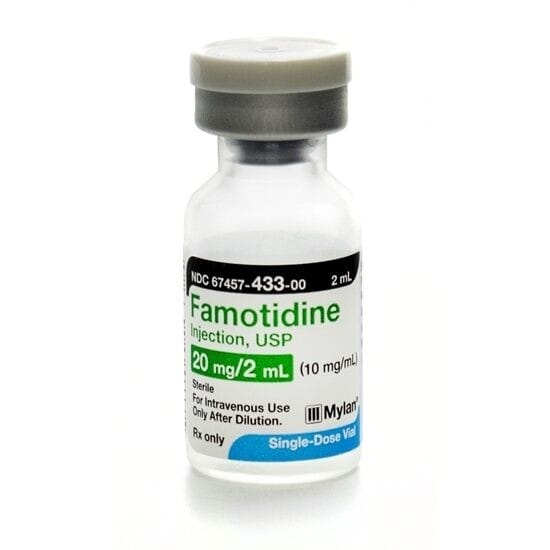
Famotidine Injection Vial
Buy Famotidine Injection Vial Online
Secure Encrypted Payments
Famotidine Injection Vial is an injectable H2 blocker used to reduce stomach acid when an oral medicine is not suitable. You can buy Famotidine Injection Vial online, view the current price, and choose the vial strength shown during ordering that matches your clinician’s directions. It is intended for intravenous use under healthcare supervision, commonly as an IV push or diluted infusion.
This medicine may be used in hospital or clinic settings for short-term acid suppression, including situations involving ulcers, reflux-related acid injury, or excess acid production. Famotidine does not move food through the stomach or neutralize acid already present; it lowers new acid output by blocking histamine H2 receptors in the stomach lining.
Price, Vial Strength, and Ordering
Famotidine injection price depends on the vial size, concentration, quantity, and supplier. During ordering, choose the available strength and quantity that match the treatment plan written by your healthcare professional. Commonly referenced presentations include famotidine 10 mg/mL vials, such as 20 mg/2 mL, 40 mg/4 mL, or 50 mg/5 mL formats, although the exact vial format can vary by manufacturer and supply channel.
Customers paying out of pocket can use the displayed cash price to plan ahead. If your care team expects repeat use, confirm the vial quantity, administration setting, and timing before purchasing. BorderFreeHealth offers US delivery from Canada for this product through licensed pharmacy channels, with prompt, express shipping used as the service context when applicable.
Quick tip: Match the concentration, total milligrams, and vial count to the directions from your healthcare professional before checkout.
What Famotidine Injection Is Used For
Famotidine injectable solution is used when acid suppression is needed and oral tablets are not practical. It may be used for active ulcers, gastroesophageal reflux disease when acid control is needed, and conditions that cause high stomach acid output, including Zollinger-Ellison syndrome. It is also used in care settings where people cannot swallow medicines or are temporarily unable to take anything by mouth.
For reflux-related symptoms, the goal is to reduce acid exposure so irritated tissue can heal and symptoms may improve. For ulcer disease, lowering acid can support healing while the underlying cause is addressed. Related condition information is available for gastroesophageal reflux disease, peptic ulcer disease, and gastric acid hypersecretion.
Famotidine Injection Vial is not a pain medicine, antacid chewable, or antibiotic. If ulcer symptoms are related to an infection such as H. pylori, separate testing and treatment may be needed. If reflux symptoms continue after therapy changes, your clinician may consider lifestyle factors, other acid-reducing medicines, or evaluation for another cause.
How the IV Vial Works
Famotidine is an H2 receptor antagonist. Histamine is one signal that tells gastric parietal cells to release stomach acid. By blocking H2 receptors, famotidine reduces both the amount of acid produced and acid concentration in the stomach.
The injection form can be useful when a rapid, supervised route is needed or when swallowing tablets is not possible. It is typically given by intravenous injection over several minutes or as an infusion over a longer period after dilution when directed by the official label and facility policy. It should not be used by intramuscular injection unless a specific product label and healthcare protocol support that route.
When eating and swallowing become reliable again, many care plans move from IV famotidine to oral acid-reducing therapy. The timing of that transition depends on the condition being treated, kidney function, symptom control, and the broader care plan.
IV Push, Infusion, and Dilution Basics
Famotidine injection for IV use may be administered as a slow IV push or as a diluted IV infusion. Dilution may be used to achieve the concentration, administration rate, and line compatibility required by the label or care-site protocol. The exact process can differ by manufacturer, vial type, and the fluids used in the facility.
Healthcare professionals typically inspect the vial for particles or discoloration before use. They also confirm the concentration, total dose, route, rate, and compatibility with other medicines in the IV line. Lines are flushed according to facility procedure, and the vial is handled as sterile medication.
Why it matters: Proper IV preparation helps reduce irritation, dosing errors, and line-compatibility problems.
Strengths, Forms, and Vial Types
Famotidine sterile vial products are supplied as injectable solutions. Many presentations use a 10 mg/mL concentration, including single-dose vial formats such as famotidine 20 mg/2 mL injection vial. Some manufacturers also supply larger vials, including 4 mL, 5 mL, or multiple-dose formats, depending on the market and supplier.
| Product attribute | Practical meaning |
|---|---|
| Active ingredient | Famotidine, an H2 blocker |
| Route | Intravenous use under healthcare supervision |
| Common concentration | 10 mg/mL in many vial presentations |
| Single-dose vial | Used once, then discarded according to medication-waste procedures |
| Multiple-dose vial | May contain a preservative; handling follows the specific label |
Read the specific carton and vial label when the medicine arrives. Single-dose and multiple-dose vials can have different handling requirements, beyond-use timing, and excipients. For broader stomach-acid treatment browsing, the gastrointestinal medicines category can help you find related therapy areas.
Who May Need Extra Caution
People with a known hypersensitivity to famotidine or other H2 blockers should not use this medicine unless a clinician determines a safe alternative plan. Significant kidney impairment can increase exposure to famotidine, so dose interval changes or monitoring may be needed. Older adults may be more sensitive to dizziness, confusion, or mental status changes, especially when kidney function is reduced.
Discuss pregnancy, breastfeeding, severe illness, recent gastrointestinal bleeding, and unexplained weight loss with a clinician. Acid suppression can improve symptoms while a more serious problem remains present. New trouble swallowing, black stools, vomiting blood, severe chest symptoms, or persistent abdominal pain should be evaluated promptly.
Famotidine injection is usually a short-term parenteral option. Long-term acid control is often managed with tablets or another maintenance plan once oral therapy is suitable.
Side Effects, Warnings, and Monitoring
Common side effects can include headache, dizziness, constipation, diarrhea, nausea, fatigue, or irritation at the injection site. These effects are often mild, but they still matter when you are recovering from illness, using other medicines, or receiving IV therapy in a monitored setting.
Serious reactions are uncommon but require urgent attention. Seek medical help for rash, swelling, breathing difficulty, severe dizziness, fainting, chest symptoms, unusual heartbeat, severe confusion, or signs of a serious allergic reaction. Liver enzyme changes, blood count changes, and heart rhythm effects have been reported with H2 blockers, especially in medically complex situations.
Monitoring may include kidney function, symptom response, mental status in older adults, and the ongoing need for IV therapy. If symptoms return after switching from injection to tablets, do not restart or increase therapy without clinical direction. Your care team may need to reassess the diagnosis, the dose schedule, or other medications.
Drug Interactions and Line Compatibility
Famotidine raises stomach pH by reducing acid production. That change can affect medicines that need an acidic environment for absorption, including certain azole antifungals and some antiretroviral medicines. Your medication list should include non-prescription products, supplements, minerals, and intermittent therapies so the clinician can identify timing issues or alternatives.
Famotidine generally has fewer cytochrome P450 enzyme interactions than cimetidine, another H2 blocker. Still, lower acid levels can influence absorption, and kidney function can influence famotidine exposure. If you are using several IV medicines, the pharmacy or clinical team should confirm line compatibility before medicines share tubing.
Do not mix famotidine injection with other injectable medicines in the same line unless compatibility has been verified. Cloudiness, precipitation, or color change after mixing can signal a problem and should be handled by trained staff.
Storage, Handling, and Travel
Unopened vials are typically stored at controlled room temperature and protected from excessive light. Avoid freezing. Once a vial is opened or a dose is diluted, stability depends on the product label, concentration, diluent, container, and storage conditions used by the healthcare setting.
A famotidine single-dose vial should be used once and discarded properly, even if liquid remains. Multiple-dose vials must be handled according to the manufacturer’s directions and facility infection-control policy. Keep all medicines away from children and pets, and do not use a vial if the solution contains particles, looks discolored, or the container is damaged.
If you travel with vials for administration at a clinic or infusion site, keep them in the original packaging with treatment documentation. Pack the medicine to prevent breakage, protect it from temperature extremes, and confirm handling requirements before leaving home. Products sourced from Canada may have packaging that reflects Canadian supply channels.
What to Expect During Treatment
Acid suppression begins after dosing, but symptom improvement depends on the reason for treatment. Reflux irritation and ulcer pain may take time to settle, especially if inflammation is ongoing. In hospital settings, staff record scheduled doses, watch for response, and adjust the care plan as oral intake returns.
If a scheduled dose is missed in a clinical setting, the care team decides the next step. Do not double a dose or self-administer IV medication. For outpatient infusion appointments, call the clinic if timing changes or if a vial has been exposed to heat, freezing, or damage.
The end point is often a step-down plan. That may mean oral famotidine, another acid reducer, or condition-specific treatment. Lifestyle steps for reflux, ulcer-risk review, and testing for contributing causes may also be part of longer-term management.
How It Compares With Other Acid Reducers
H2 blockers and proton pump inhibitors both reduce stomach acid, but they do so at different points in acid production. H2 blockers such as famotidine block histamine-driven acid signaling. Proton pump inhibitors act later in the acid-producing pathway and often provide stronger, longer suppression for some erosive conditions.
An H2 blocker injection can be practical when oral therapy is not possible or when short-term supervised acid control is needed. A PPI may be preferred later for certain diagnoses, while an oral H2 blocker may be enough for others. Your clinician’s choice depends on diagnosis, severity, kidney function, other medicines, and response.
For broader education on digestive medicines and acid-related therapy decisions, the gastrointestinal articles section covers related topics. These materials can help frame questions for a clinician, but they should not replace individualized care.
Questions to Discuss Before Use
- What condition is the IV famotidine treating right now?
- Will the dose be given as an IV push or diluted infusion?
- How will kidney function affect the dose or interval?
- Which medicines could absorb differently when stomach acid is reduced?
- When might oral therapy replace the injection?
- What symptoms should trigger urgent medical attention?
- How should unopened vials be stored before administration?
Bringing these questions to your care team can make ordering and use safer. It also helps you avoid buying the wrong strength, quantity, or vial type for the planned setting.
Authoritative Sources
For label-level and patient-facing drug information, consult official references. These sources support safety, administration, storage, and clinical-use discussions:
Use the official vial label that accompanies your medicine for manufacturer-specific dilution, stability, storage, and administration directions.
This content is for informational purposes only and is not a substitute for professional medical advice.
Research & Education Tool
Famotidine Injection Vial Dosage Calculator
Enter the vial amount, diluent volume, and target amount to estimate concentration, draw volume on a 1 mL U-100 syringe, and approximate vial yield.
For research and educational use only. Check all values against the product label, certificate of analysis, and any applicable professional guidance before relying on the result.
mg
Concentration
-
mcg / mL
Volume per Dose
-
-
Estimated Draws / Vial
-
rounded down to whole draws
Draw Reference
Enter values to estimate the syringe mark.
0
-
-
-
-
eGFR Calculator
Estimate kidney filtration using the 2021 CKD-EPI creatinine equation.
eGFR
-
mL/min/1.73 m2
G category
-
requires clinical context
These calculations are for education only and do not replace clinical advice, diagnosis, or treatment. Always confirm medical decisions with a qualified healthcare professional.
Creatinine Clearance Calculator
Estimate creatinine clearance using the Cockcroft-Gault equation.
CrCl
-
mL/min estimate
These calculations are for education only and do not replace clinical advice, diagnosis, or treatment. Always confirm medical decisions with a qualified healthcare professional.
Express Shipping - from $29.99
Shipping with this method takes 3-5 days
Prices:
- Dry-Packed Products $29.99
- Cold-Packed Products $39.99
Shipping Countries:
- United States (all contiguous states**)
- Worldwide (excludes some countries***)
Standard Shipping - $19.99
Shipping with this method takes 5-10 days
Prices:
- Dry-Packed Products $19.99
- Not available for Cold-Packed products
Shipping Countries:
- United States (all contiguous states**)
- Worldwide (excludes some countries***)
What is famotidine 20 mg/2 mL injection vial used for?
Famotidine 20 mg/2 mL injection vial is a 10 mg/mL IV famotidine presentation used to reduce stomach acid when oral therapy is not suitable. It may be used for acid-related conditions such as ulcers, reflux-related acid injury, or excess acid production under healthcare supervision.
Is there an IV form of famotidine?
Yes. Famotidine is available as an injectable solution for intravenous use. It may be given as a slow IV push or diluted infusion, depending on the product label and clinical setting.
Why does IV famotidine sometimes need to be diluted?
Dilution can help achieve the required concentration, infusion time, and IV line compatibility for safe administration. The exact dilution fluid, concentration, and stability time depend on the manufacturer’s label and facility protocol.
What side effects can famotidine injection cause?
Common side effects may include headache, dizziness, constipation, diarrhea, nausea, fatigue, or injection site irritation. Serious allergic reactions, severe confusion, chest symptoms, or unusual heartbeat require urgent medical attention.
How should famotidine injection vials be stored?
Unopened vials are generally stored at controlled room temperature, protected from excessive light, and kept from freezing. After dilution or opening, follow the specific product label and healthcare facility handling rules.
Rewards Program
Earn points on birthdays, product orders, reviews, friend referrals, and more! Enjoy your medication at unparalleled discounts while reaping rewards for every step you take with us.
You can read more about rewards here.
POINT VALUE
How to earn points
- 1Create an account and start earning.
- 2Earn points every time you shop or perform certain actions.
- 3Redeem points for exclusive discounts.
You Might Also Like
Select options
This product has multiple variants. The options may be chosen on the product page
Select options
This product has multiple variants. The options may be chosen on the product page
Select options
This product has multiple variants. The options may be chosen on the product page
Select options
This product has multiple variants. The options may be chosen on the product page